


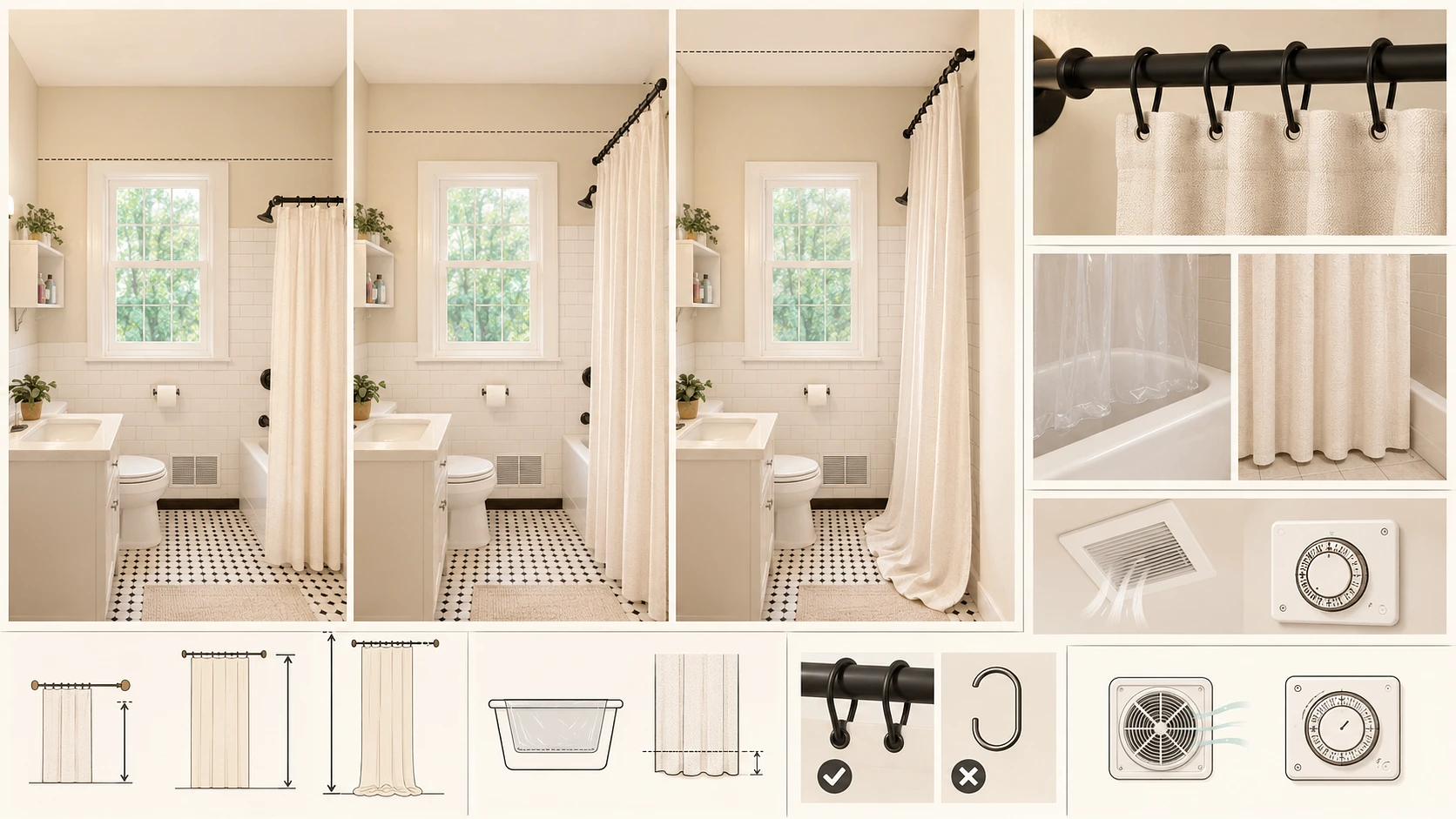
Your 72 inch curtain is doing what a 72 inch curtain does at builder height. It stops about 2 feet below the ceiling and cuts the wall across at the worst spot. Nothing is broken. It just looks wrong once you have seen it, and now you cannot unsee it. Going longer is the right instinct. Jumping to 96 is where I would slow you down.
The Measurement That Settles It
Rod height is curtain length plus the hooks plus your floor clearance. Hooks eat 2 to 3 inches, you want an inch or two of gap at the bottom, so a 72 inch curtain lands the rod at 75 to 77 inches, which is where yours already is. An 84 puts it at roughly 88. A 96 puts it around 100.
Go measure your ceiling. A standard 8 foot ceiling gives you 96 inches of wall and the 96 inch curtain needs about 100. The math runs out before the wall does. Hang it anyway and the hem pools on the tile, which is the exact moisture problem you were trying to avoid, showing up from the other direction.
At 9 foot ceilings the 96 makes sense. Under that it is a curtain shopping for a room you do not have.
Buy The 84
Rod around 88 inches, hem clearing the floor by an inch, roughly 8 inches of wall left above so the rod is not shoved into the drywall.
What that height buys you is one unbroken vertical from near the ceiling to the floor. Nothing interrupts it. The tub reads as the bottom of a tall panel instead of a squat box with a short curtain hovering over it. Identical tub, identical square footage, and the room looks taller because the wall stopped getting sliced into thirds.
Check width while you are at it. Standard curtains are 72 inches wide and the rule is your opening plus about 12 inches so the fabric actually folds. A tall rod with a flat, pulled tight curtain looks worse than what you have now.
Black Rod, Black Hooks
Fine by me. Your shower arm and tub spout are already matte black so the rod is not a new decision. Get hooks that roll though, not the stamped C hooks. Longer rod, heavier curtain, more weight dragging every single time, and one that catches and hangs crooked up at 88 inches looks a lot worse than one that catches at 75.
The Moisture Thing Is About Your Liner
You are worried about the right problem and looking at the wrong piece of fabric.
The decorative curtain hangs outside the tub. It never touches water. It can be as long as your wall allows and it is not a mold risk.
The liner is what has to be short. It goes inside the tub, and the hem needs to land an inch or two inside the rim so water runs down the plastic and drips back into the tub. That is why liners often come cut at 70 or 71 inches instead of a full 72. On purpose.
So you want them mismatched:
- Outer curtain at 84, outside the tub, hem near the floor.
- Liner at standard length, inside the tub, hem well above the tile.
The way people actually create mildew is buying a matching 84 inch liner and letting it hang outside the tub or sit on the floor. Wet plastic on tile between showers wicks and stays damp. Length was never the danger. Length in the wrong position was.
Your Fan Is Doing More Work Than Any Curtain
In a Florida bathroom in August the room is fighting you before the water is even on, and no curtain choice out engineers a weak exhaust fan. The Department of Energy’s guidance puts the minimum at 50 CFM for a fan you switch on and off, and recommends running it a full hour after the shower rather than the 15 minutes most of us give it.
A timer switch costs about 30 dollars and takes that decision away from you. Buy the 84, keep the liner short and inside the tub, and put the fan on a timer. The room will look a foot taller by Saturday.