


Somebody lit the lamps this morning. Five carved wooden panels, painted in faded coral, teal and ochre with lotus stems, peacocks and a flowering tree climbing the tallest one in the middle, stand in a stepped arrangement behind a low wooden altar. Brass oil lamps with live flames, beeswax candles burning down, a small dark stone deity wearing a bead garland, a printed yantra propped against a clay pot, jasmine blossoms and a red hibiscus laid out fresh on the step. The panels are the back wall of a working shrine. They are not decorating that corner. They are furnishing a daily ritual, which is a different job and the one they were carved for.
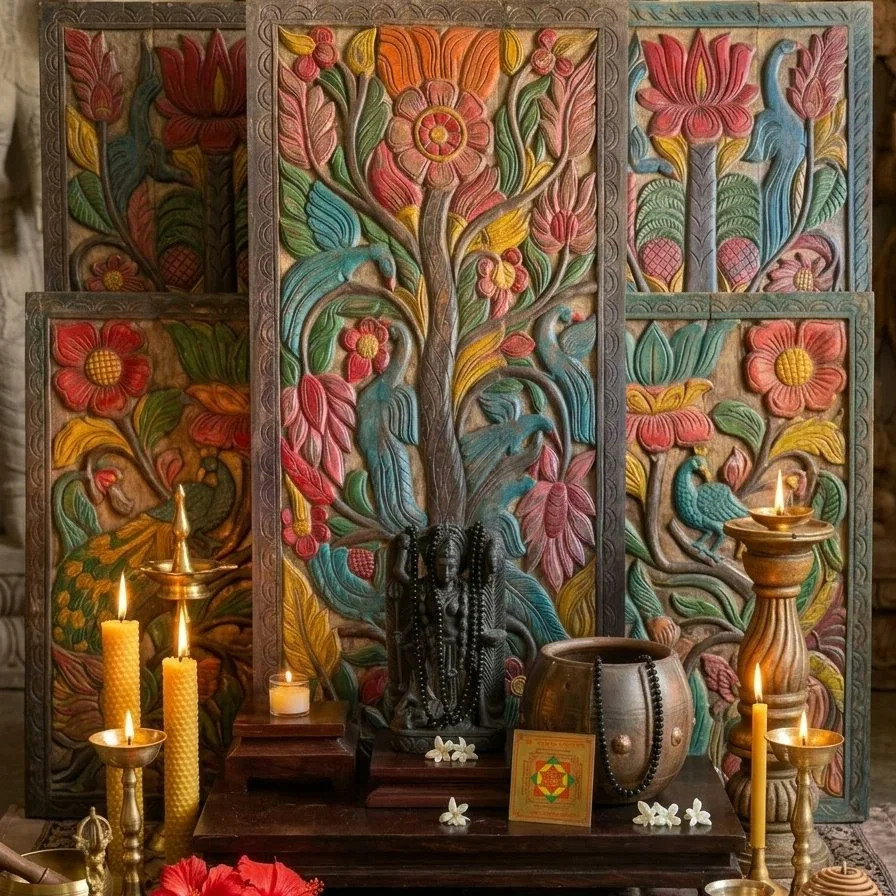
That distinction runs through every piece of carved Indian salvage that ends up in a house outside India. The ones that look right have a job: they close a room, frame a passage, back an altar, hold a threshold. The ones that look like inventory are the ones hung flat on a wall as pictures, which is what most of them become.
A Carved Panel Needs A Job, Not A Wall
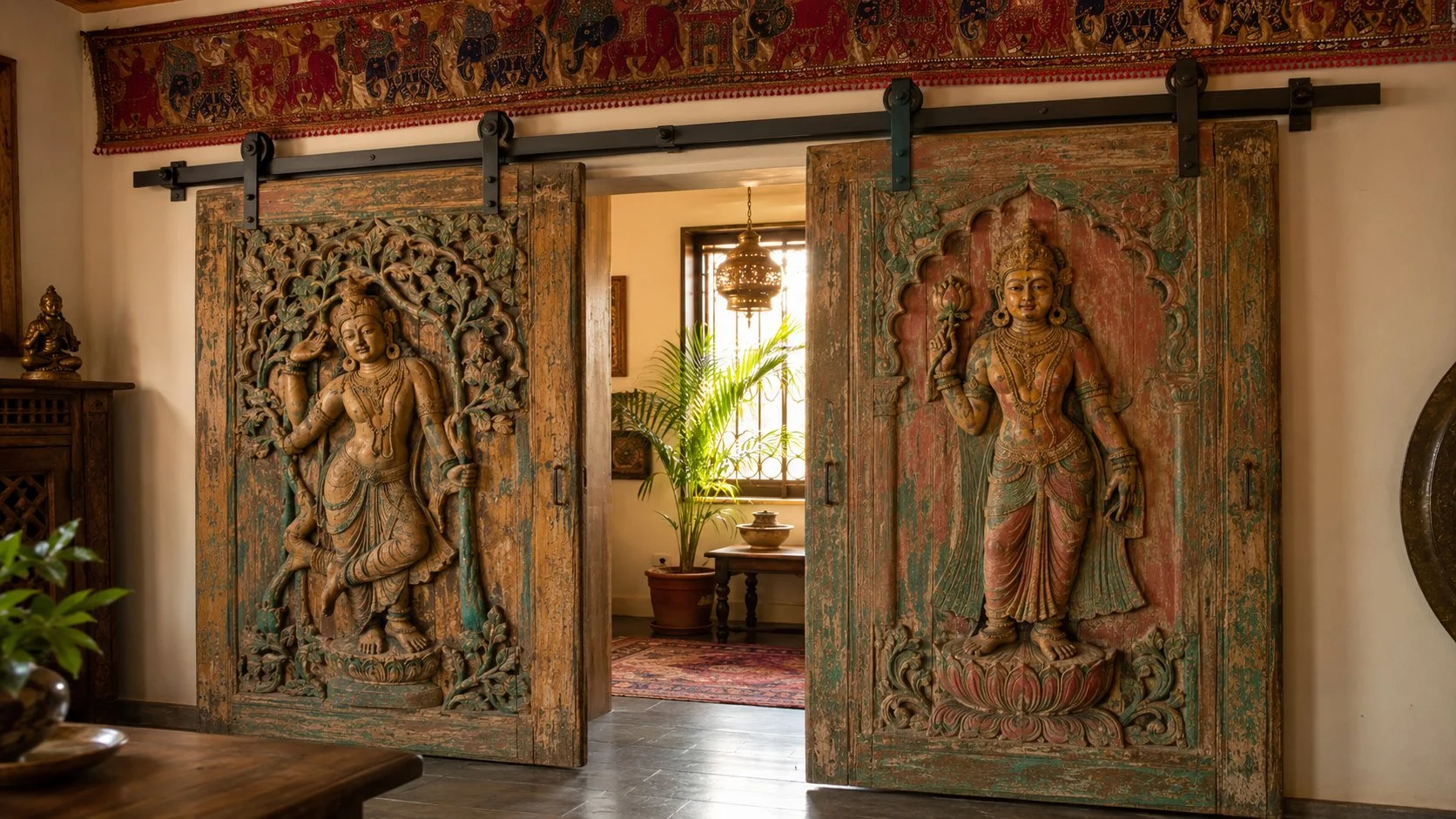
The pieces come from a dealer’s floor, which is worth seeing first. A relief-carved Ganesha nearly a door tall, seated within a lotus arch, mace and goad in two hands, painted in worn ochre and brick red with green and gold borders, leans against a stack of other salvaged doors and screens in a plant-filled shop. Fiddle-leaf figs, a bird of paradise, pothos trailing from terracotta, succulents in glazed pots, a brass planter, a small gray stone Ganesha on the floor in front. It’s a beautiful object and it’s stock. Nothing is asking it to do anything.

Once a panel is installed as a moving wall or a doorway, what changes is not decoration. Function returns. These pieces were made as doors, jharokha frames, shutters, temple screens. Carving that deep was meant to be read from a threshold, at the moment of passing through, not scanned from a sofa across a room. Give a panel back a passage and the carving starts making sense again, because the eye meets it the way it was designed to be met, close and in motion.
Hanging Heavy Teak On A Barn-Door Track
The most convincing installation of the set is two carved panels hung on a black steel sliding track across a wide doorway. The left panel shows Krishna with his flute, a cow at his feet, deep relief under a canopy of vines. The right shows a dancing figure, arms raised, over a lotus base, the carving washed in a green-blue patina. Above the track hangs a long embroidered textile of processional elephants in red and indigo. Beyond the gap between the doors, a small octagonal table, a palm, a brass lantern in a curtained window. Slide either door and the room changes shape. That’s the job.
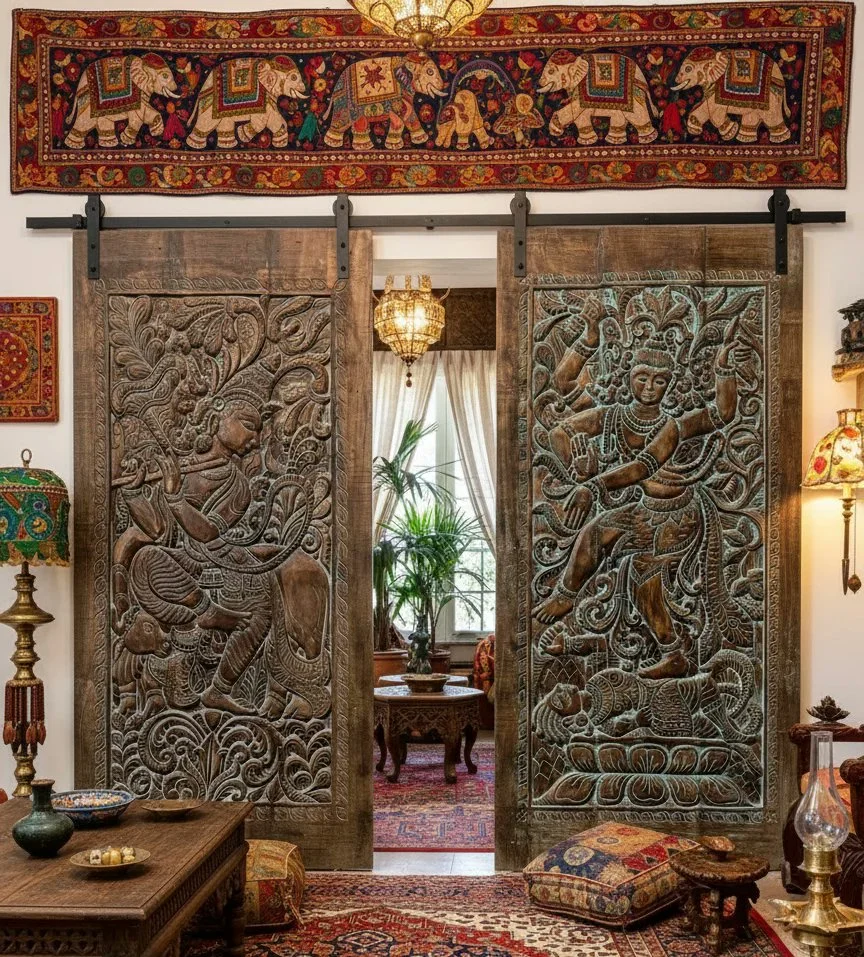
Doing it safely is mostly arithmetic. Solid teak at door size is far heavier than the pine slabs consumer barn-door kits are designed for. The kits say so. A standard interior kit lists a door weight capacity around 170 pounds, with a note that the wall must be strong enough to hang a heavy panel before buying. Heavy-duty flat track and box rail hardware runs 400 to 800 pounds, rated per pair of hangers, so two doors each need a kit rated for the individual door’s weight. Three things decide whether a carved door slides for twenty years or comes off the track once:
- Weigh the door yourself or get the dealer to. Guessing is how the 170-pound kit ends up under a 260-pound panel. Round up to the next fifty pounds of rating, since running hardware at 95 percent of capacity leaves no margin.
- The track carries into studs or a header, never drywall anchors. The track should be twice the width of the door panel so it can slide fully clear.
- A floor guide at the bottom. Without one, a heavy carved door swings like a pendulum and takes the wall finish with it.
The other thing worth knowing about that track: it turns two panels into a room divider that opens, which is the job a bookcase or a folding screen from the furniture aisle usually gets. The carved version costs more, weighs five times as much and does something neither can, which is disappear into the wall on demand.
Arches, Frames, Thresholds
An arch does the same job without moving. A carved teal-painted doorframe with a cusped Mughal-style arch, fluted columns and dense floral relief stands inside a glass-walled garden room, framing a sliding glass door onto ferns, bananas and a small stone waterfall. Beside it, set into a plaster wall, an old studded wooden door with a carved surround, a bronze Buddha seated on a plain wooden bench in front, framed devotional prints on the shelves. Nobody walks through the carved arch to get anywhere the glass door wouldn’t take them. It exists to make the passage feel like one.

A threshold works the same way even with nothing overhead. A gray stone Buddha, one hand raised, seated against a carved leaf-shaped backplate on a low wooden plinth, sits square in an open doorway between a tiled meditation room and a jungle garden, jute rugs and a sheepskin on the floor, folded blankets on a bench, carved wooden panels flanking the door on the interior side. The statue stops the doorway from being a doorway. It becomes a place you stop.
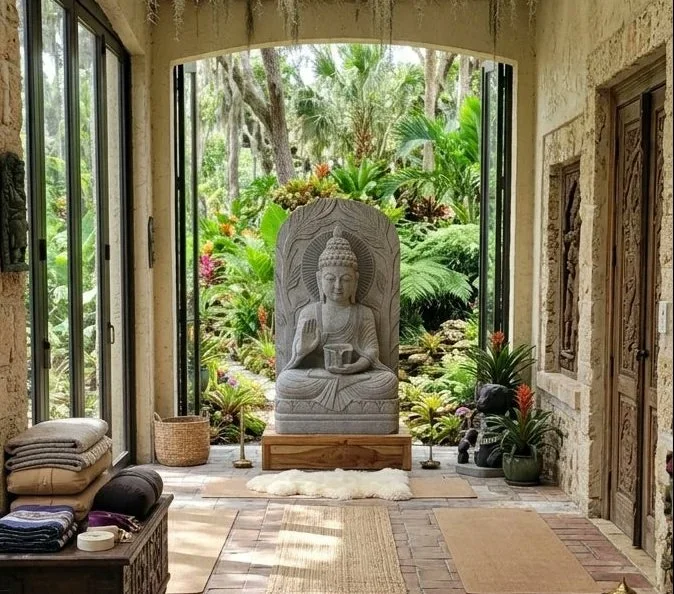
One note that applies to both rooms, since they mix a Buddha with Hindu-carved architecture the way a lot of Bali-influenced decor does. A Buddha figure is a devotional image too. The same courtesies that apply to a Ganesha panel apply to it: raised off the floor, upright, not in a bathroom, not used as a table. Both rooms manage that. The plinth and the bench are doing quiet work.
What Weather Does To Teak And What It Does To Marble
The last installation is outdoors, a garden alcove between weathered timber posts. A white marble Shiva and Parvati seated together, a small Ganesha between them, on a stone plinth gone green with moss, in front of a dark carved wooden panel bearing Ganesha in relief. To one side, a painted panel of a dancing woman in red, the paint softening at the edges. Frangipani in the corner, ferns at the base.

It’s the most romantic photograph of the six and the one with a clock running. Teak survives outdoors, which is why it built ships, but carved teak survives differently from a flat plank: fine relief holds water in every recess, the surface silvers, hairline checks open along the grain, painted detail goes first. The dancing woman’s reds will be a memory in a few seasons of that damp. The marble couple, by contrast, will outlast the posts they stand between. Stone belongs in the garden. Carved wood visits it.
For anyone set on wood outside, a roof over it matters more than any oil, since the damage is standing water rather than sun. The panel should stand on stone or a raised sill, never on soil. The one in this alcove sits under timber and above a stone floor, which is why the carving still reads at all.
A carved teak door weighs roughly what a refrigerator weighs. Anyone who has moved one twice stops thinking of it as art.