


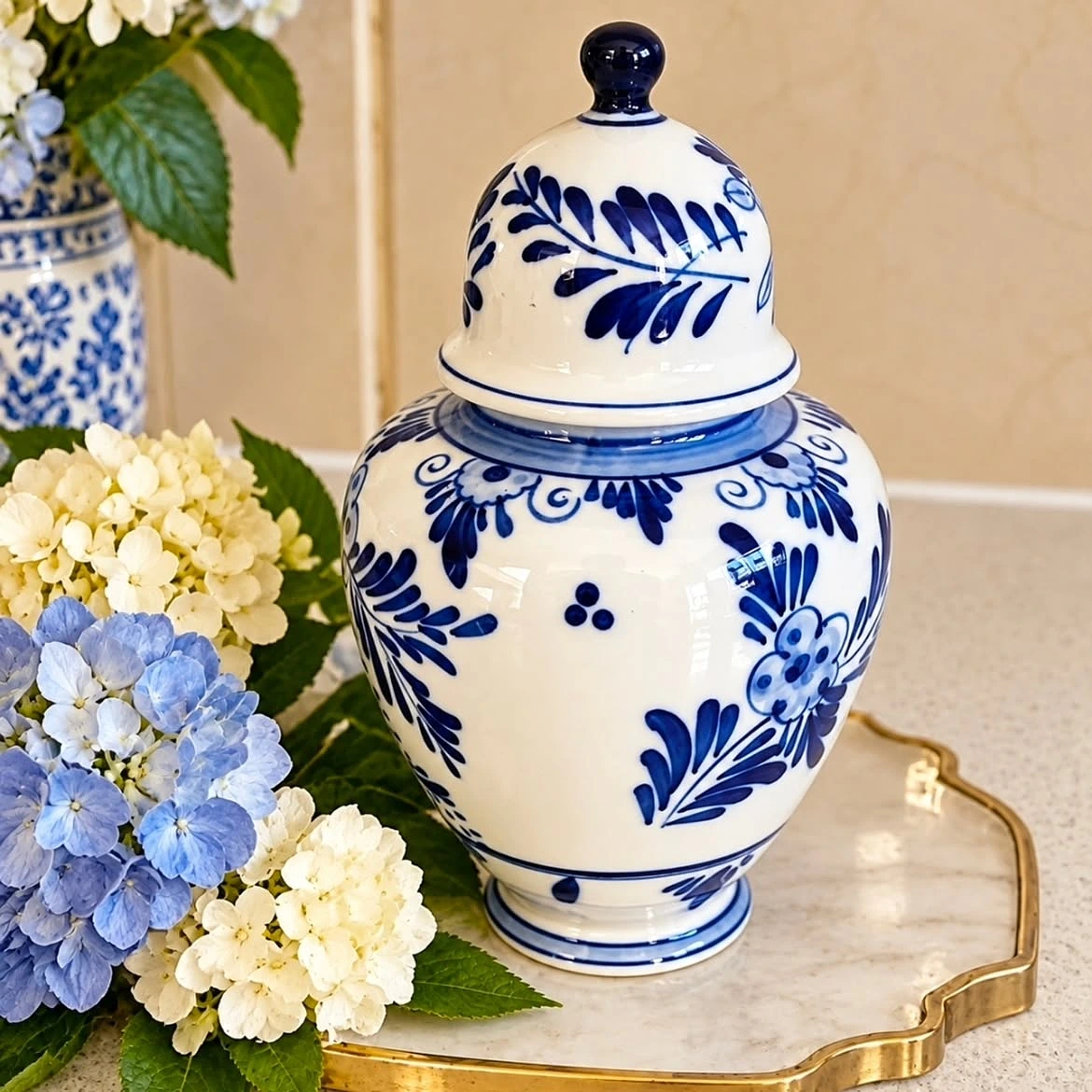
Ginger jars have been around for a very long time, and for most of it they weren’t decor at all. They were kitchen jars in China, plain storage for salt, oil and spices, and the shape there is still just called guan, meaning jar. Traders in the West called them ginger jars because of what was packed inside when they arrived. Somewhere along the way people stopped caring what was in them and started buying them for the painting on the outside, and by the 19th century they were collected for that alone, as this guide to collecting Chinese ginger jars describes. So if you own one, or three, and can’t work out where they go, you’re in good company.
1. Blue And White Is The Easiest Color To Live With
If you’re only going to have one, get a blue and white one. Green, yellow and pink jars are lovely, but they can be fussy about where they sit, while blue and white gets along with white walls, gray sofas, navy bedding and pretty much any wood tone you throw at it.
Got a beige living room that feels a little flat? One blue jar on a side table will fix that faster than a new rug.
2. Put It Somewhere Flat And Square, Away From Other Round Things
Most of the charm of a ginger jar is in its shape, fat and round with a little dome on top, and it shows up best when everything around it is straight. A square side table, the end of a long TV console or the top of a dresser will all do the job nicely. The dresser is my pick, since it puts the jar at about eye level and you can see the pattern without bending down.
The one place to avoid is a round pedestal table, especially with a round lamp next to it. Too many curves in one spot and the jar turns into one more round thing. If that corner needs rethinking, these living room layouts show where side tables and consoles usually work best.
3. Two Or Three Jars Look Better Than Six
It’s easy to get carried away. You buy one, a friend gives you another, you find a third at a thrift store, and before long there are six of them on one shelf next to candles and photo frames, and none of them stand out anymore. Pulling a few off the shelf and giving the rest some room is usually the fastest fix.
Mantels Look Best With A Matching Pair
One jar at each end, a mirror or a painting in the middle, and you’re done. If the mantel is very long you can tuck a smaller jar off to one side so it doesn’t look like a hotel lobby.
Bookshelves And Sideboards Need Space Between The Jars
On a bookshelf, one jar per shelf is plenty, and it looks better if you zigzag them, left side on one shelf and right side on the next. A small jar can sit on two or three books laid flat to lift it up. A sideboard can take three jars in three sizes, tallest at the back, and they don’t have to match:
- Different patterns in the same blue look collected over time.
- Different colors work too, as long as one color clearly leads.
4. In A Modern Room, Stop At One
A white kitchen with flat doors and black handles can look a little cold. Put one big blue and white jar on the counter by the window and it warms right up, and the kitchen still looks modern. Add two more and you’ve got a country kitchen.
5. Take The Lid Off And Use It As A Vase
This one surprises people. With the lid off, the wide mouth holds long branches, magnolia, eucalyptus or dried pampas grass beautifully, and it looks heavier and more grown up than a glass vase. Just put the lid somewhere you’ll remember, because a ginger jar without its lid is a much harder thing to sell or pass down later.
If the jar is old, check it for hairline cracks before pouring any water in. When in doubt, drop a glass jar inside as a liner, or go with dried stems and skip the water.
Branches can change with the seasons, too, and a few seasonal home decor ideas can help you plan what goes in the jar through the year.
6. Use It To Hide Clutter, But Keep Food Out Of Old Jars
A ginger jar with a lid is a handy place to stash keys by the front door, remotes on the coffee table or cotton balls in the bathroom. That’s pretty close to what it was made for in the first place.
Food is different, at least with old or handmade jars. Some traditional glazes contain lead, and the FDA specifically warns about antique and traditional pottery for that reason. Some decorative pieces even have a warning stamped on the bottom, so flip the jar over and look for a “Not for Food Use” mark.
Keep cookies, candy and loose tea in jars sold for the kitchen.
7. Check The Mark Before You Display It
A lot of blue and white jars have a Kangxi mark on the base, which points to 1662 to 1722, but that mark alone doesn’t mean much. Plenty were made in the 19th century with the mark added as a tribute, and the word is also used loosely for a style. Weight tells you more. Jars made before the 1800s tend to be surprisingly heavy for their size.
If you’ve inherited one that feels heavy, or picked one up at an estate sale, I’d keep it on a high shelf, away from the dog’s tail and the kids’ elbows, until an appraiser has had a look.