


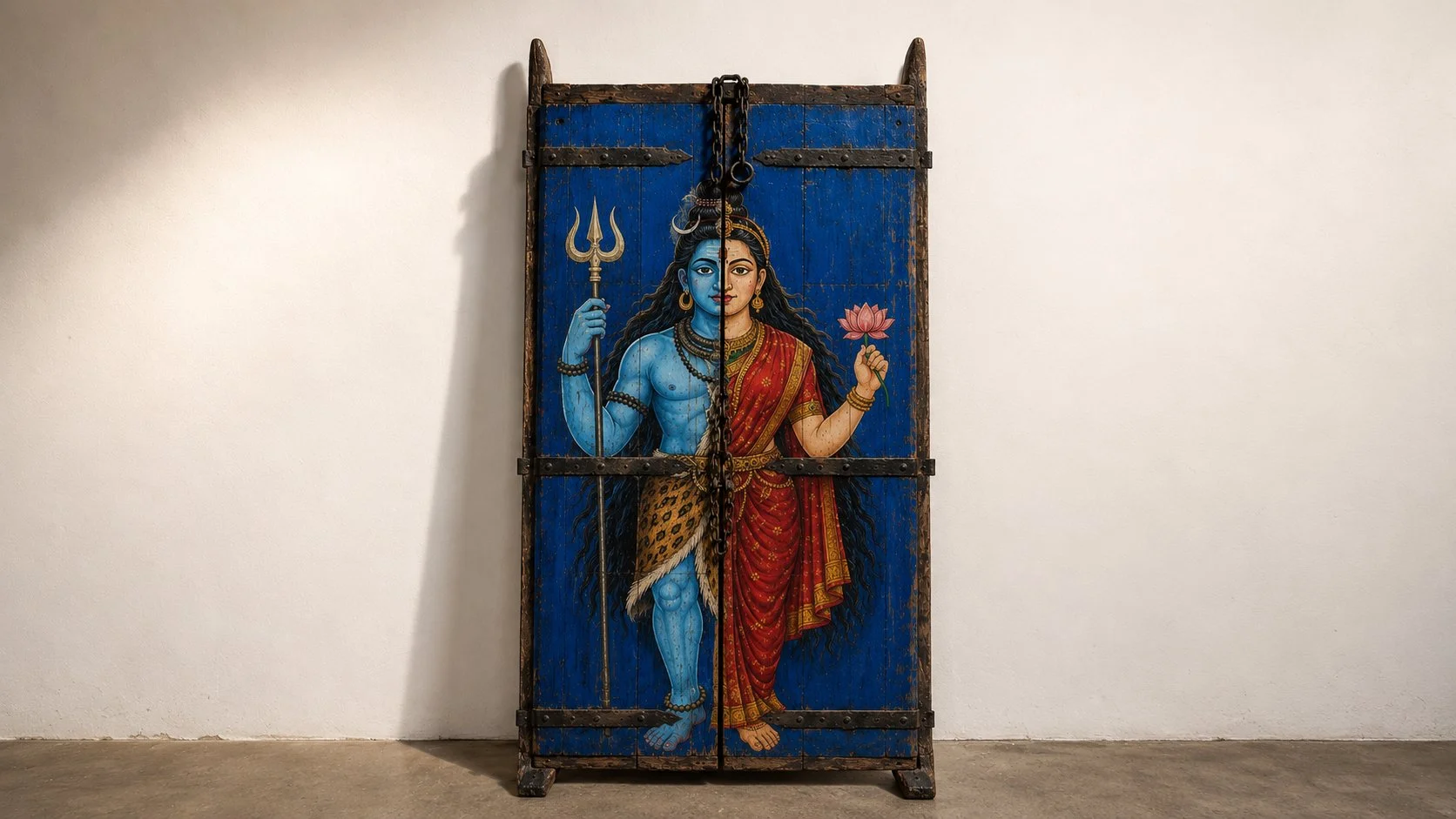
A door painted edge to edge with a figure that is two figures. Down a cobalt blue ground runs a body split at the center line, the left side sky-blue and bare-chested with a trident, the right side fair-skinned in a deep red sari holding a pink lotus, black hair streaming off both shoulders in opposite directions. An iron chain still hangs from the top rail. Two horn-like posts stand past the upper corners, two iron-shod feet stick out below. This object weighs as much as a person. It stood in a doorway for decades. It is now for sale as art.
Buying one is easy. Dealers ship them worldwide. Knowing what you have bought is the part that takes ten minutes of attention, because these are not patterns, they are specific deities with names, stories and, for a billion people, live devotional meaning. The figures on the seven doors in this set are worth learning before any of them goes on a wall.
These Were Working Doors, The Hardware Proves It
Start with the carpentry, since it answers the first question buyers ask, which is whether these are real doors or reproductions built for export. Salvage dealers source them from old havelis and homes across Rajasthan, Gujarat and South India, built from dense old teak and similar hardwoods, reinforced with ironwork, their hand-joined planks showing regional carpentry that goes back centuries. The tells are readable on the objects themselves. The posts projecting past the top corners and the iron-capped feet at the bottom are pivots: the door turned in socket holes cut into lintel and sill, the way doors hung before butt hinges, which is why nothing here has hinge plates. The horizontal iron straps crossing the planks are the reinforcement that kept a plank door from racking. The chain and ring on the face is the hasp it locked with.
The paint deserves one honest question at the point of sale. Wood this weathered wearing color this crisp usually means the painting is far newer than the door. There is nothing wrong with that as long as nobody paid an antique-painting price for it. Sellers say so themselves when you read the listings closely, describing heritage doors from Rajasthan and Gujarat that they have changed and reworked to suit today’s interiors. The wood is old. The god was often painted last year. Ask the dealer when the painting was done, then decide what the answer is worth to you.
Sizes run tall. These read close to seven feet, which is normal for haveli doors. Solid teak at that height is a two-person lift with wall anchoring to match.
The Composite Deities Most Buyers Cannot Name
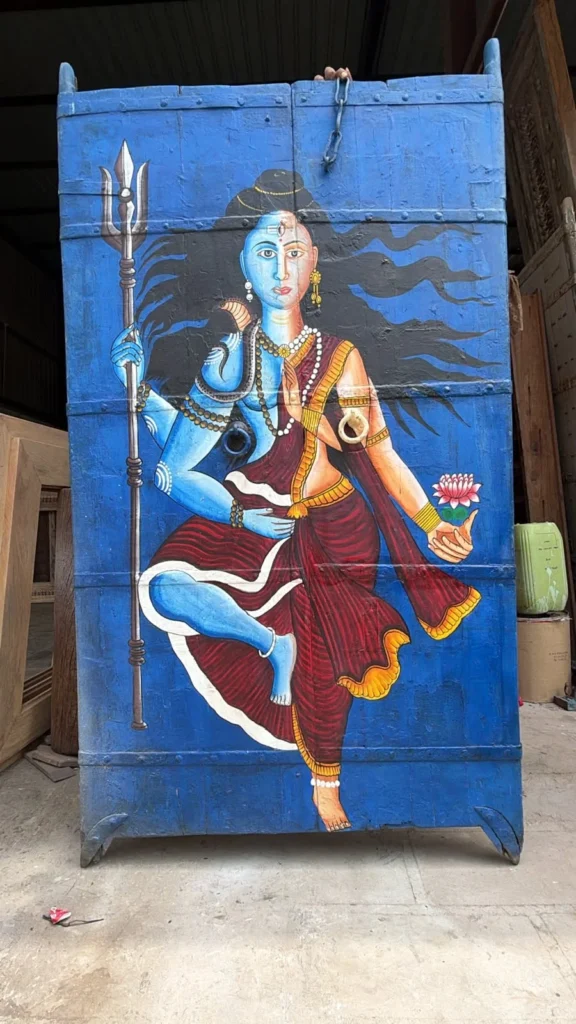
The split figure from the blue door has a name. It is one of the oldest ideas in Hindu art. Ardhanarishvara is the composite male-female form of Shiva together with his consort Parvati. In sculpture across India and Southeast Asia the right half of the figure is the male, carrying Shiva’s traditional ornaments, matted hair, the half third eye, serpents, while the left half is Parvati, hair combed and knotted, the eye lined, a silk garment and anklet. The form represents the synthesis of masculine and feminine energies, the teaching that Shakti and Shiva are inseparable, their union the root of all creation.
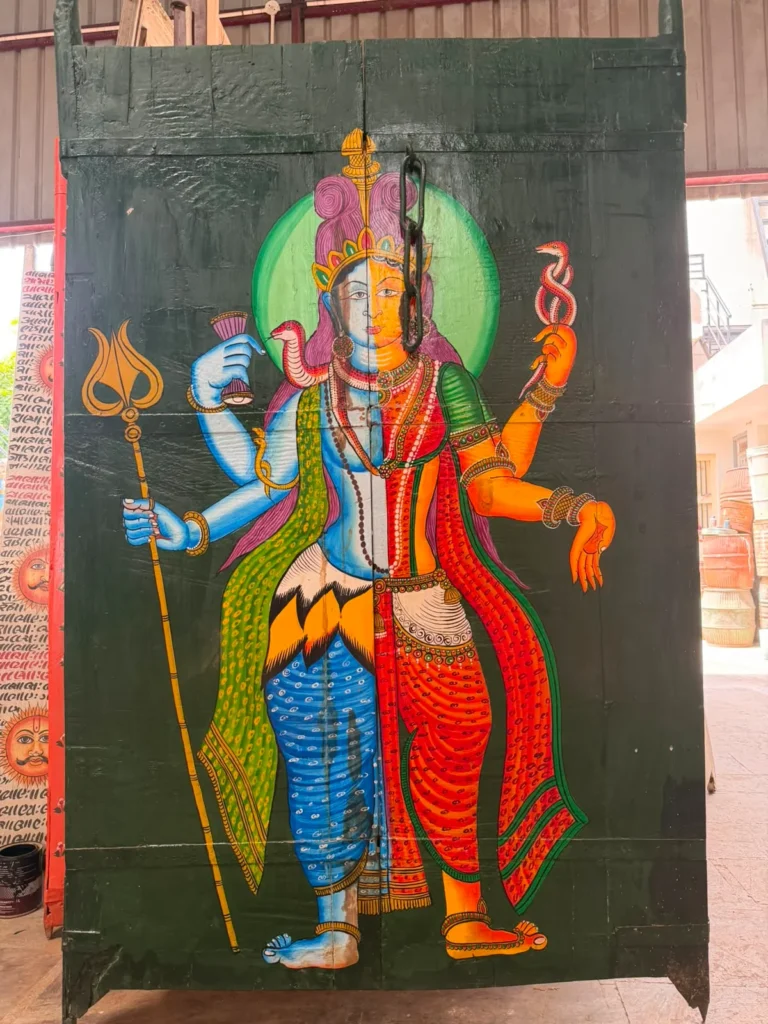
A second door in this set carries the same deity on a dark green ground, the Shiva half in blue with patterned dhoti, the Parvati half in orange and red with a serpent coiled up one arm. And on both doors the painters did something quietly perfect: the dividing line of the deity runs along the center joint where the two door leaves meet. The theology and the carpentry share a seam. When the door stood in its frame, opening it would have parted the two halves.
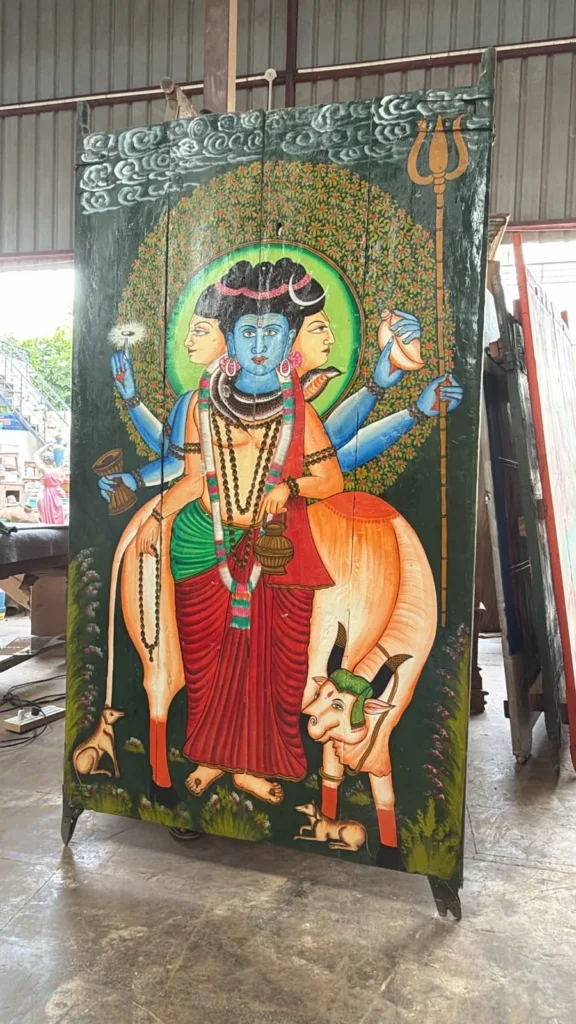
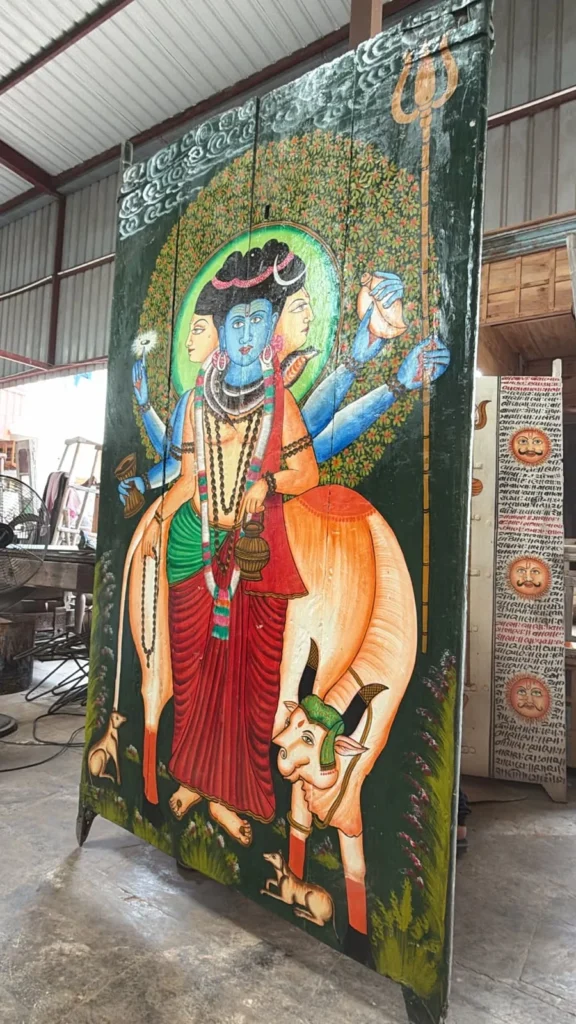
The other unfamiliar figure rides a cow. Three faces on one head, one blue and two flesh-toned in profile, six arms fanned out holding a trident, a conch, a water pot and prayer beads, a green halo ringed in flowering foliage behind, small dogs in the grass at his feet. This is Dattatreya, depicted with the three heads of Brahma, Vishnu and Shiva and six arms carrying their iconography, accompanied by a cow symbolizing sanctity and traditionally by four dogs representing the four Vedas. He is the whole Trimurti standing in one body, which makes a door bearing him one of the more theologically loaded objects a living room can hold.
Ganesha And Hanuman Carry Their Stories In The Small Details
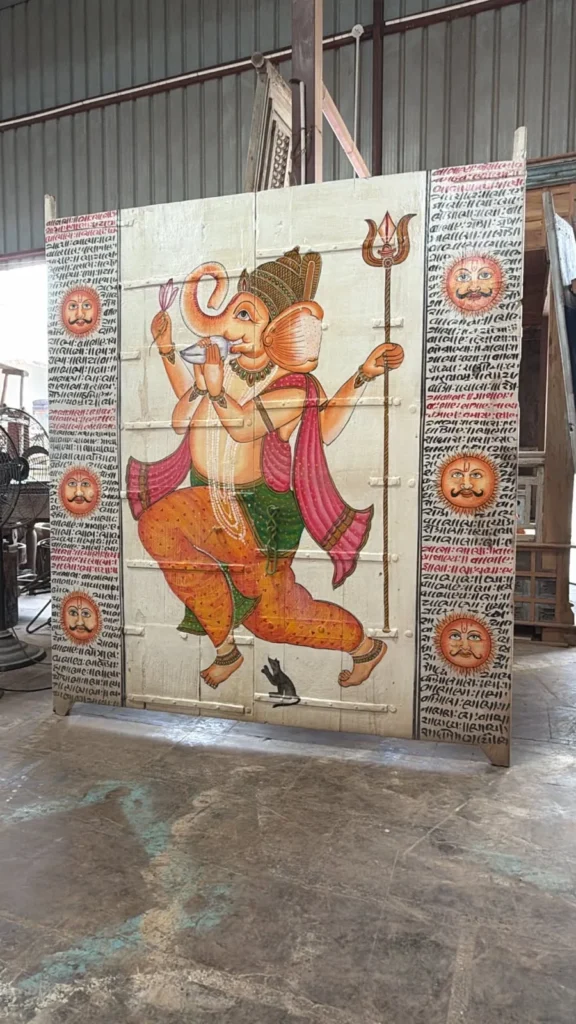
The two recognizable figures reward the same close reading. A cream-colored door carries Ganesha striding with a trident staff, a conch at his lips, framed by side borders filled with rows of hand-lettered Gujarati devotional script and mustachioed sun faces. Sunburst motifs, the Surya Chakra, sit among the standard ritual symbols painted on traditional Indian doors alongside the lotus and Om. Down by his back foot, easy to miss, a small gray mouse. The mouse, Mushaka, is Ganesha’s vahana, his vehicle. Among his devotees the mouse has become a minor deity in his own right. A Ganesha without the mouse is a portrait. With it, the image is complete.
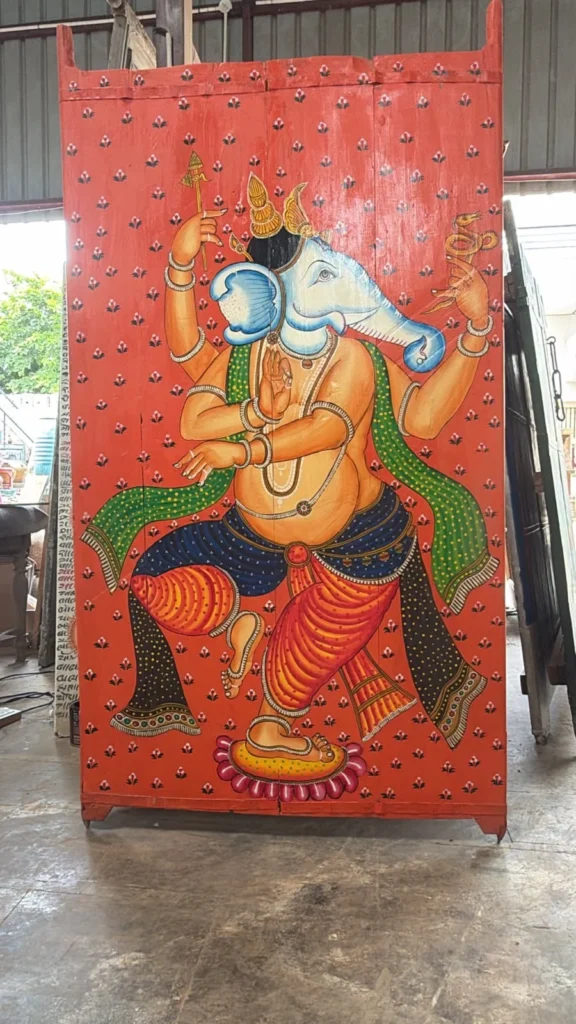
A second Ganesha, on a tomato-red ground scattered with tiny flower sprigs, dances with one foot on a lotus cushion, green sash flying, a serpent held aloft in one of four hands. The dancing form against that repeating floral field is the most purely decorative door of the seven, closer to textile than to icon painting, which is worth knowing when choosing between them: the striding Ganesha with its script borders is a devotional object that happens to be a door, the dancing one leans the other way.
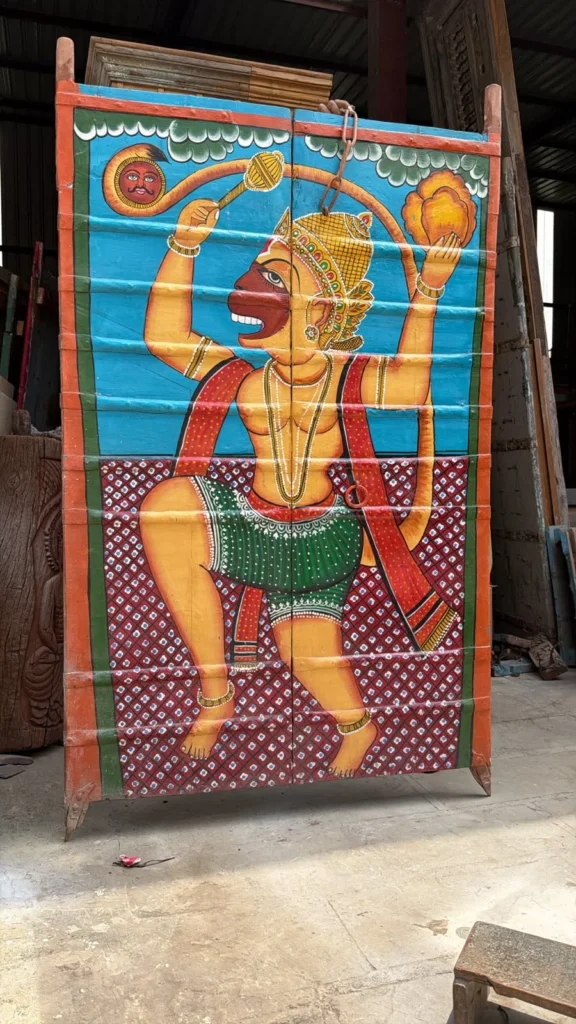
The last figure is mid-leap. Orange border, blue sky with scalloped clouds, a powerfully built monkey-faced figure in a green dhoti with a golden crown, one arm raising a mace, the other holding up a rounded mass, a small red sun face tucked in the corner. This is Hanuman. The mass in his hand is a mountain: the Ramayana episode where, unable to identify the one healing herb needed to save Lakshmana, he lifts the entire Himalayan peak and carries it to the battlefield. It is the image of strength in service. That is why Hanuman guards so many thresholds. A door was a fitting place for him long before anybody thought of hanging one in a hallway.
Where A Painted Deity Can Go In A Home And Where It Should Not
The traditions around these images did not stop applying when the door left India. A buyer with no religious stake in them loses nothing by following the broad rules. For practicing households they are live guidance, drawn from Vastu convention:
- At an entrance, a Ganesha image belongs on the inside of the main door at eye level, around four to five feet, facing into the home rather than out toward the street.
- Deity images are raised, never placed at floor level, out of reverence.
- Bathrooms, storerooms, garages and the space under a staircase are avoided for deity images altogether.
For everyone else, the same list translates into simple respect: hang it upright, hang it high, keep it out of the bathroom, never lay it flat as a tabletop. A seven-foot teak door bearing Dattatreya was made to stand at a threshold, so the uses that honor it are the ones that keep it vertical and visible, mounted as a wall panel behind a bed or sofa, hung as a sliding room divider, set into a frame as an actual interior door on heavy cleats rated for the weight. Anyone who loves the imagery but not the two hundred pounds can get the same iconography in framed painting prints at a fraction of the weight and none of the structural work.
The chain is the detail that stays with you. Every door in this set still carries its hasp, the iron loop and links that once locked a family’s house for the night. Whatever wall one of these ends up on, the chain will hang there beside a god, locking nothing, still attached.