


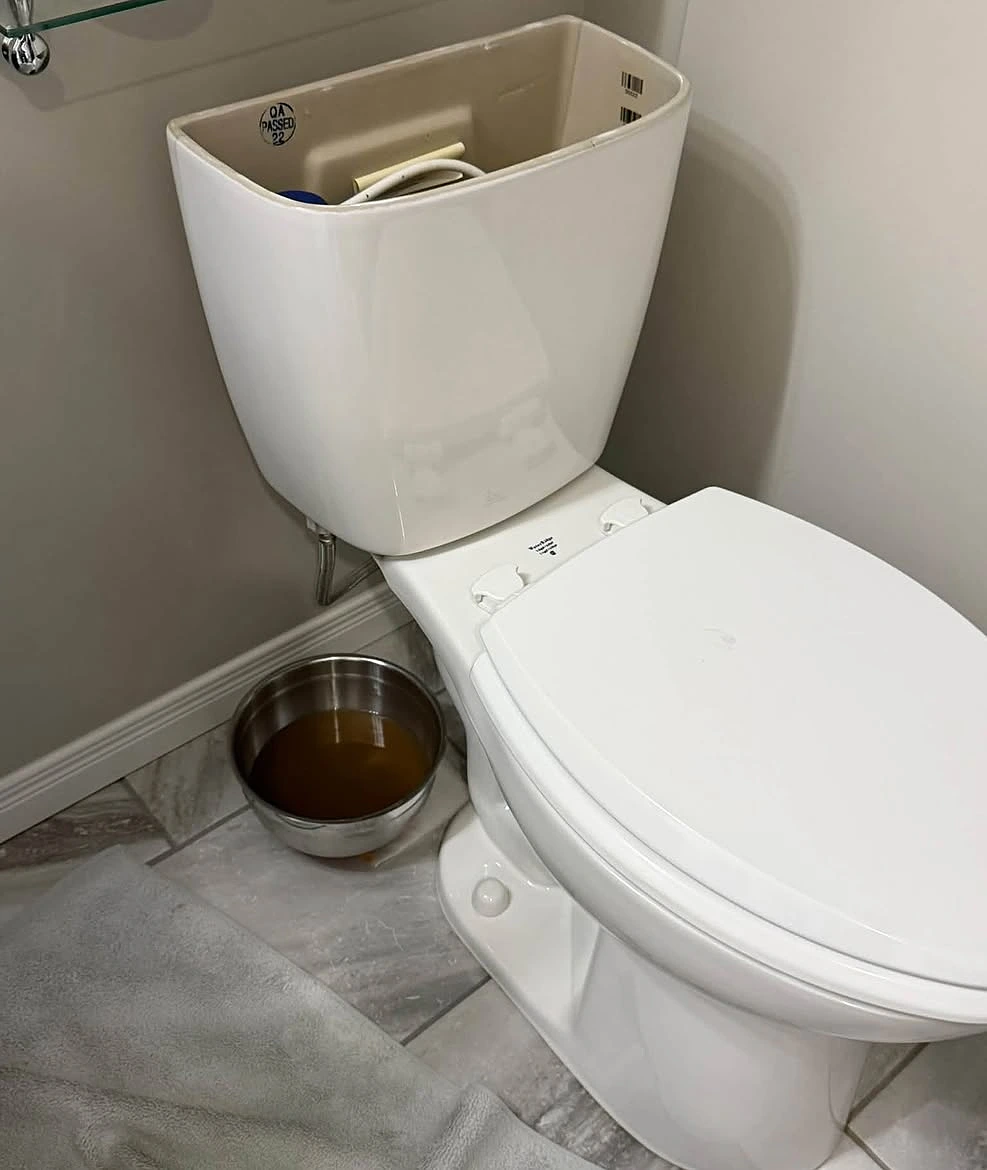
The detail that matters is the one you already noticed. The water drops, then the tank refills itself back up to the line, and nothing flushed. Water only leaves a cistern through two routes. It goes down into the bowl, or it goes up and over the overflow tube. If your fill valve were the problem, the level would sit at the line or above it and the water would pour steadily into that overflow pipe. It would not drop first.
So the water is escaping downward, past the seal at the bottom of the tank, into the bowl. The fill valve is doing exactly what it was built to do. It senses a low level and tops it back up, over and over, all day and all night. Plumbers call this a phantom flush.
Confirm It With Food Coloring In Ten Minutes
Do not order any parts until you have run this. It takes no tools and it is the same test water utilities hand out to customers.
- Put several drops of food coloring into the tank, not the bowl.
- Leave it alone for 10 to 15 minutes. Nobody flushes during that window.
- Look in the bowl.
Colored water in the bowl means the seal at the bottom of the tank is leaking, and that is your repair. Clear water in the bowl while the level still drops sends you back to the overflow tube instead. Flush when you are finished or the dye will stain the porcelain.
A Leaking Seal Wastes About 200 Gallons A Day
EPA puts a typical running toilet at roughly 200 gallons every 24 hours, which works out to flushing the thing more than 50 times for no reason. A smaller, slower leak still runs around 30 gallons a day, or 900 a month.
Those are the numbers that changed how seriously I take this. A drip from a faucet looks like waste. A toilet doing the same thing sounds like nothing at all and quietly outspends it several times over, and in most of Florida you are billed for sewer on the same meter reading, so every wasted gallon gets charged twice.
Clean The Seat Before You Buy A New Flapper
This is the step people skip, and skipping it is why the second flapper leaks as badly as the first.
The flapper seals against a plastic rim called the flush valve seat. Run a finger around it. If it feels gritty, chalky or rough instead of smooth, no new rubber part is going to seat properly on it, because you are asking a flat seal to close against a ridged surface.
Shut the supply valve, flush to empty the tank, and work the seat over with a scouring pad or a rag and white vinegar. Give it a few minutes if the buildup is thick. Wipe it clean and run your finger round again before you go any further.
There is a decent chance this alone fixes it, especially on a tank that has been in service more than five or six years.
Match The Replacement To Size And Brand
Wrong part is the single most common reason a toilet still runs after somebody has already replaced the flapper.
- Measure the opening. Two inches covers most standard tanks, three inches covers TOTO and the taller tower style valves.
- Buy the same brand family as your flush valve where you can.
- Set the chain with about half an inch of slack, roughly one or two links.
- Too tight and the flapper cannot close. Too loose and it cannot open fully.
Turn the water back on, let it fill, and run the dye test a second time. Waiting a day to find out is worse than waiting ten more minutes.
Some tanks use a cartridge or a seal ring instead of a hinged rubber flapper, and a tall canister valve in a plastic frame is one of those. Same diagnosis, same seat cleaning, different part number. Take a picture of the assembly and show it at the counter rather than guessing from a shelf.
Drop-In Tablets Void Most Toilet Warranties
Blue staining inside a tank is worth talking about, because if there is a cleaning tablet sitting in there, you have found your cause.
Fluidmaster’s warranty language could not be blunter. In-tank drop-in cleaners containing bleach or chlorine will damage tank components, may cause flooding, and using them voids the warranty. Kohler, TOTO and American Standard all carry versions of the same clause.
The mechanism is simple enough. Chlorine sits in that water all night at high concentration while nobody flushes, and it strips the elasticity out of rubber. Flappers that should last four to seven years start leaking inside six to eighteen months. Manufacturers deny claims on exactly this basis, and blue dye staining in the tank is the evidence they look for.
If you want the bowl kept clean, a cup or two of white vinegar poured into the tank once a month handles scale and leaves the seals alone.
Water Is Why These Seals Fail Early
Our groundwater runs through limestone before it ever reaches the maintane house, which makes it some of the hardest water in the country. Calcium and magnesium come out of solution and build a rock hard crust on everything they touch, including that flush valve seat.
That is the local version of this problem. A flapper rated for five years somewhere with soft water will not get five years here, and a seat that looked fine two years ago is probably carrying a ring of scale now.
Worth knowing that the University of Florida extension service in Sarasota County runs free sessions on this exact repair and hands out leak detection dye tablets. Free dye and a free flapper is a reasonable deal for a fifteen minute job.
Call Somebody If It Still Runs After Two Attempts
Three situations where a plumber earns the money.
- You have cleaned the seat and fitted a correct replacement, and the dye test still comes back colored.
- The seat itself is cracked or pitted, which means replacing the whole flush valve and pulling the tank off the bowl.
- Water is appearing on the floor rather than only inside the tank.
Everything up to that point is a part costing under $15 and about twenty minutes. Past that point you are into removing tank bolts and reseating a gasket, which is where a straightforward afternoon turns into a bathroom you cannot use.