


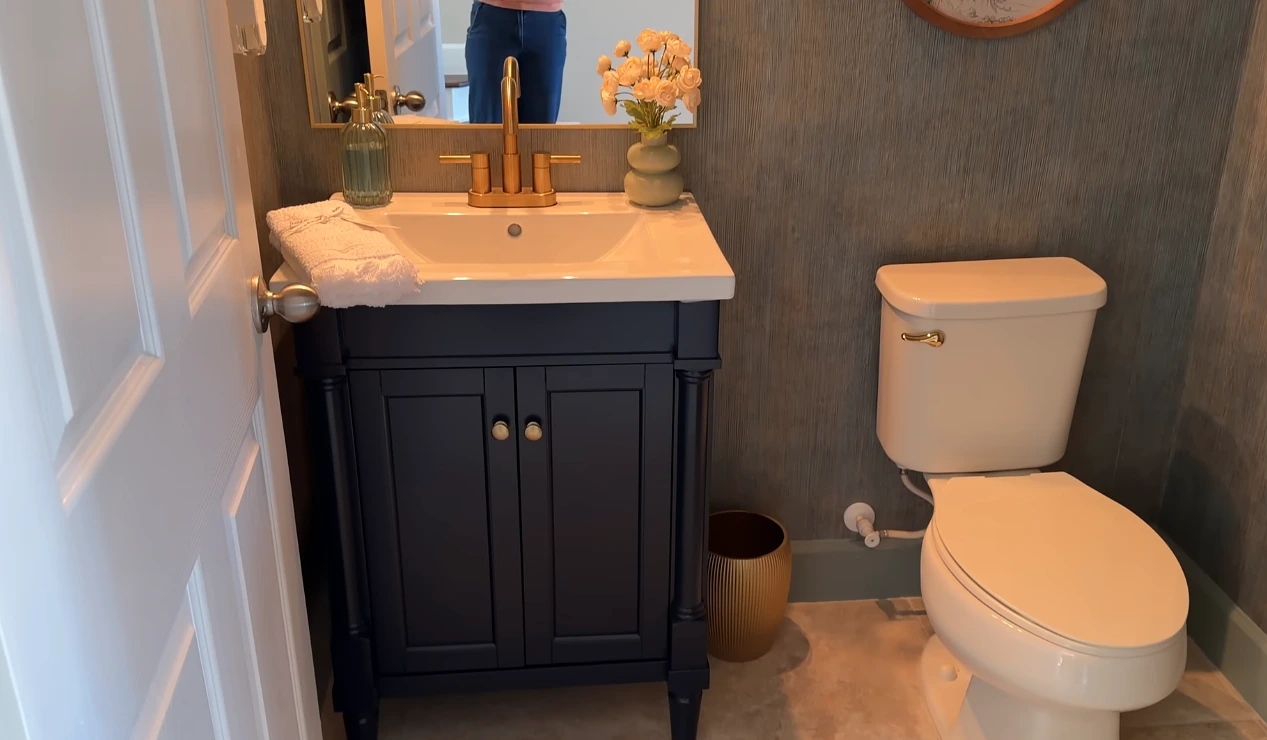
Guests end up in this room by themselves, and there is nothing in there to look at except whatever you picked. No shower means no steam, which puts a bunch of things back on the table that you cannot do in a real bathroom, and the room is only around 20 square feet, so even the expensive materials stay affordable because you need so little of them.
The money side holds up too. A powder room added to a house that only had one full bath has been valued at a return of $15,000 to $20,000, which per square foot beats any other bathroom work you can do.
1. Paper The Whole Room
An accent wall in here is a compromise, and it looks like one, because in a space this tight you end up with one busy wall and three empty ones staring at each other.
2. Why It Holds Up In A Powder Room And Fails In A Full Bath
Old fashioned cellulose paper comes apart in a family bathroom because steam works its way behind it and softens the paste. Once the adhesive lets go, the seams curl, then the edge above the baseboard curls, and the fix is stripping the whole wall.
None of that applies here. The failure mode is steam driven, and a room with no shower and no tub sits at humidity levels close to a bedroom. Standard non woven paper is fine. Peel and stick is fine too, and it comes off cleanly in 5 years when you want a different pattern.
3. The Pattern Can Be Louder Than You Think
Big florals, dark botanicals, animal print, deep Art Deco. Something that would wear you out in a living room works in a room you are in for 4 minutes.
Cost helps you here. Most powder rooms take 2 rolls, sometimes 3, so the paper you could not justify at $200 a roll now runs less than a decent light fixture.
4. Fifteen Inches And Twenty One Inches
Both are code, both get checked, and every layout decision you make bends around them.
- 15 inches from the toilet centerline to any side wall, vanity or fixture.
- 21 inches of clear floor in front of the bowl.
There is a way to fail the first one without realizing it. Frame the wall at 15.5 inches off the flange centerline, then add 3/4 inch of backerboard and tile on top, and the finished measurement comes out at 14.75. The tile is already up by the time anyone measures.
5. Round Bowls Are About 3 Inches Shorter
Elongated bowls stick out 30 to 31 inches from the wall. Round front bowls come out 27 to 28. Front clearance is usually the tightest number in a powder room and this costs nothing to change.
6. What A Wall Hung Toilet Actually Buys You
Tank goes into the wall cavity and the bowl only projects about 22 inches, so you get back 8 or 9 inches of floor in a room that might only be 60 inches deep. It changes how the room feels to stand in more than any decorative choice on this list, which is why I keep pushing people toward it.
The fixture runs $700 to $1,200 and the wall has to come open, so it belongs in a renovation. If you are already at that stage, read up on half bath layouts before the plumber sets the rough in, because moving it afterward is expensive.
7. One Fixture Above The Mirror Is The Wrong Setup
Light coming straight down puts shadows in the eye sockets and under the nose and everybody looks tired. Two sconces on either side cross the light at face height and those shadows fill in.
Center each one 60 to 66 inches off the finished floor, keep it 2 to 6 inches from the mirror edge, and put the pair somewhere in the 24 to 36 inch range apart. Measure from the floor and not from the countertop, which is where most installs go wrong.
8. CRI 90 On The Bulbs
Color rendering index decides whether skin reads as skin. Under 90 the warm tones flatten out and everyone comes back slightly gray in the mirror. Get CRI 90 or better at 2700K to 3000K.
9. Mirror Height
Center it at eye level, 57 to 65 inches from the floor, bottom edge 5 to 10 inches above the faucet. Powder room mirrors get hung too high all the time because somebody centered it on the wall rather than on the person standing there.
10. Unlacquered Brass Changes Color And That Is The Deal
It darkens where hands touch it and lightens where water runs over it, and after a year it looks nothing like the product photo. Some people love that and some people call the plumber.
I would live with a sample for a week before ordering. If a faucet shifting color is going to nag at you in month 3, buy coated satin or polished brass and you get the same warmth with none of it.
11. The Vessel Sink Arithmetic
This is the mistake I see most, and it is not a taste problem, it is addition.
A vessel bowl adds 5 to 6 inches on top of the counter. Standard vanities are 32 to 36 inches tall. Put the two together and the rim lands past 40 inches, which is around chin height for a shorter adult. The cabinet has to come down to 28 to 31 inches so the finished rim sits at 34 to 36.
Two other things nobody mentions at the showroom. Your faucet spout needs to clear the rim by 4 inches minimum, so a 6 inch bowl wants roughly a 10 inch spout height. And most vessels have no overflow, so they take an open grid drain rather than the pop up you already have in the cabinet.
12. Eighteen Inch Vanities Exist For This Room
Standard depth is 20 to 21 inches. The 18 inch versions were made for powder rooms and that 3 inches is noticeable when the room is 5 feet across. Pedestals are prettier and hold nothing, which matters more than people expect in a room where guests look for a place to set a phone down.
Float the vanity if the plumbing allows it. Seeing floor run underneath the cabinet does more for the sense of space than paint color does.
13. Pocket Doors
A swinging door claims a quarter circle of floor that nothing else can use, and in a room this size that is the whole difference between comfortable and awkward.
14. Real Art Survives In Here
Framed pieces warp in a full bathroom within a couple of years, which is why everyone tells you not to hang anything good in one. That advice does not apply to a room with no steam in it. Small pieces, hung low enough to actually read from a foot away.
15. Something Alive On The Counter
Cut stems in a small vase when people are coming over, or a pothos if you want something that lives without you. Most powder rooms have no window, so anything permanent has to be genuinely happy in low light.
What Does To All Of This
In a lot of houses down here the powder room is the one closest to the lanai door, which quietly makes it the pool bathroom whether that was the plan or not. Wet feet, sunscreen, sand, and a swimsuit dripping on whatever you chose for the floor.
So the priorities shuffle around:
- Porcelain or luxury vinyl instead of unsealed stone.
- A hook rather than a delicate ring, and a towel you will not miss.
- Darker grout, because sunscreen wipes off tile and stains grout.
Salt air also speeds up the patina on unlacquered brass, so the finish your friend has in Ohio will move faster on your faucet. And the wallpaper argument is slightly weaker here than up north, since a house sitting at 55% humidity in August is feeding that little room too, shower or no shower.
It does not stop you papering it. It means the exhaust fan is still doing a job, and people down here treat running it as optional when it is not. If you only do 3 things, paper the room, get the sconces at the right height, and check the vessel sink math before anything gets ordered.