

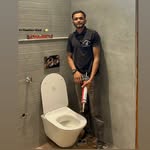
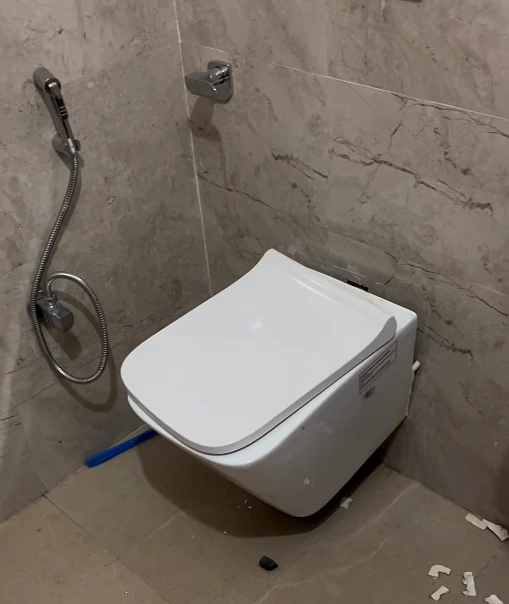
“Sasta roye baar baar, mehanga roye ek baar.” Our elders say it about buying. The cheap thing makes you cry again and again, and the expensive thing makes you cry once. In this house the seat cost about ₹20,000 and the fitting was the cheap part.
Today we are going to see what a second plumber found when he took that seat off the wall and put it back. There were 2 mistakes behind the tiles. If you are building a house right now you could check for both before the bathroom is plastered.
A few figures to hold on to while the story goes along.
- A branded wall hung Toilet seat from Jaquar, Kohler, Grohe or Hindware costs ₹15,000 to ₹25,000. Basic pans on IndiaMART start near ₹2,350.
- These pans are built to hold 400 kg for an hour without bending, under the EN 997 standard.
- The plumber unwound 15 to 20 turns of Teflon tape from one inlet joint that needed a single rubber washer.
The case: a guest bathroom seat in Dehradun that came away from the wall.
The plumber puts his videos up as HR Plumber Mind, from Dehradun. The client had built a guest bathroom, had the mistri fit a wall hung seat in it, and hardly used the room after that. Then guests came to stay for a few days, they used the bathroom, and the seat pulled out of the wall. It did not crack. The plumber calls that luck.
Wall Hung Seats Fixed Into Bare Brick Work Loose
A wall hung Toilet pan hangs on 2 threaded bolts, the rag bolts, which go through the back of the pan into the wall. Everything the pan carries goes through those 2 bolts and into whatever they are sunk in. In a proper installation they are sunk into a steel frame that stands on the floor, so the weight goes down to the floor. In a lot of our bathrooms the bolts go straight into the brick with no frame. Brick around a bolt hole crumbles under a load that keeps moving, and the hole widens a little with each use.
Now, why would it fail in a bathroom that was hardly used?
Because it was never tight to begin with. A guest bathroom gets no load for months and then 3 days of it, and a fixing that was loose from the first day gives way on the first weekend it is properly used.
A Wall Hung Pan Is Built To Hold 400 kg
The pan was never the weak part. 400 kg sitting on it for an hour with no deformation, and the frames sold alongside are tested to about the same figure. When a seat comes off a wall the ceramic has passed that test. The part that failed sits between the pan and the wall, and the plumber chose it.
Mild Steel Rag Bolts Rust And The Allen Key Slips
He started by taking the seat off. One of the 2 allen key bolts came out. The other one would not move. Water had got into it over the years, the mild steel had rusted, and when he put the allen key in, the key turned in the socket without turning the bolt. He got it out in the end. He does not say how long it took, only that it was very difficult, and that in plenty of houses a seat in this state gets broken to get it off the wall because the bolt never comes.
The room being unused makes no difference here. The bolts sit behind a ceramic pan in a wet room, the caps over them are for looks and not for sealing, and water reaches the steel in any bathroom.
Jaquar Sells A Stainless Rack Bolt As A Separate Part
His request to the companies is short. If a seat costs ₹20,000, make the bolt that holds it in brass and not mild steel, so it can be undone 5 years later without the key slipping. He mentions that Dehradun Plumbing Technical, another channel from the same city, has said the same on video.
One company has already gone part of the way. Jaquar lists a stainless steel rack bolt for WC fitting in its accessories. Stainless rather than brass, and it does not rust either. So the bolt our plumbers are asking for is in the catalogue as an extra, the mild steel one still comes in the box, and a fitter who knows about the stainless one asks for it at the time of fitting.
A rusted mild steel bolt is why a wall hung seat cannot be taken down for repair without breaking it.
Teflon Tape On A Rubber Washer Joint Causes The Leak
With the seat off the wall he went to the inlet pipe, the one that carries water from the concealed cistern into the pan. He started unwinding tape from the joint and kept going, and he holds it up to the camera and counts, 15 turns, maybe 20. This is the part that annoyed him more than the rust, and you can hear it in how he says it.
That joint is not made to take tape. The inlet connection comes in the box with a black rubber washer, and the washer is the seal. You put the washer on, you tighten the nut, and the rubber does the sealing. His guess is that the first mistri did not know the washer was there, or lost it, and tried to make up for it with tape.
PTFE Tape Goes Only On Tapered Threads
This part is not one plumber’s word against another’s. Toolstation’s guide says that PTFE tape should not be used on connections with rubber washers or O rings, because the seal is already in the fitting and tape stops it seating, which gives you the leak the tape was meant to prevent. Too much tape also stops the nut going all the way down.
Tape belongs on a tapered thread, a shower arm or a tap tail, where the thread itself makes the seal. A joint with a washer, an olive or an O ring goes together dry.
- Rubber washer joints and compression joints take no tape.
He put the washer on, tightened the nut with a clean thread, and hung the seat back on its bolts. The only new part in the whole job was that washer.