


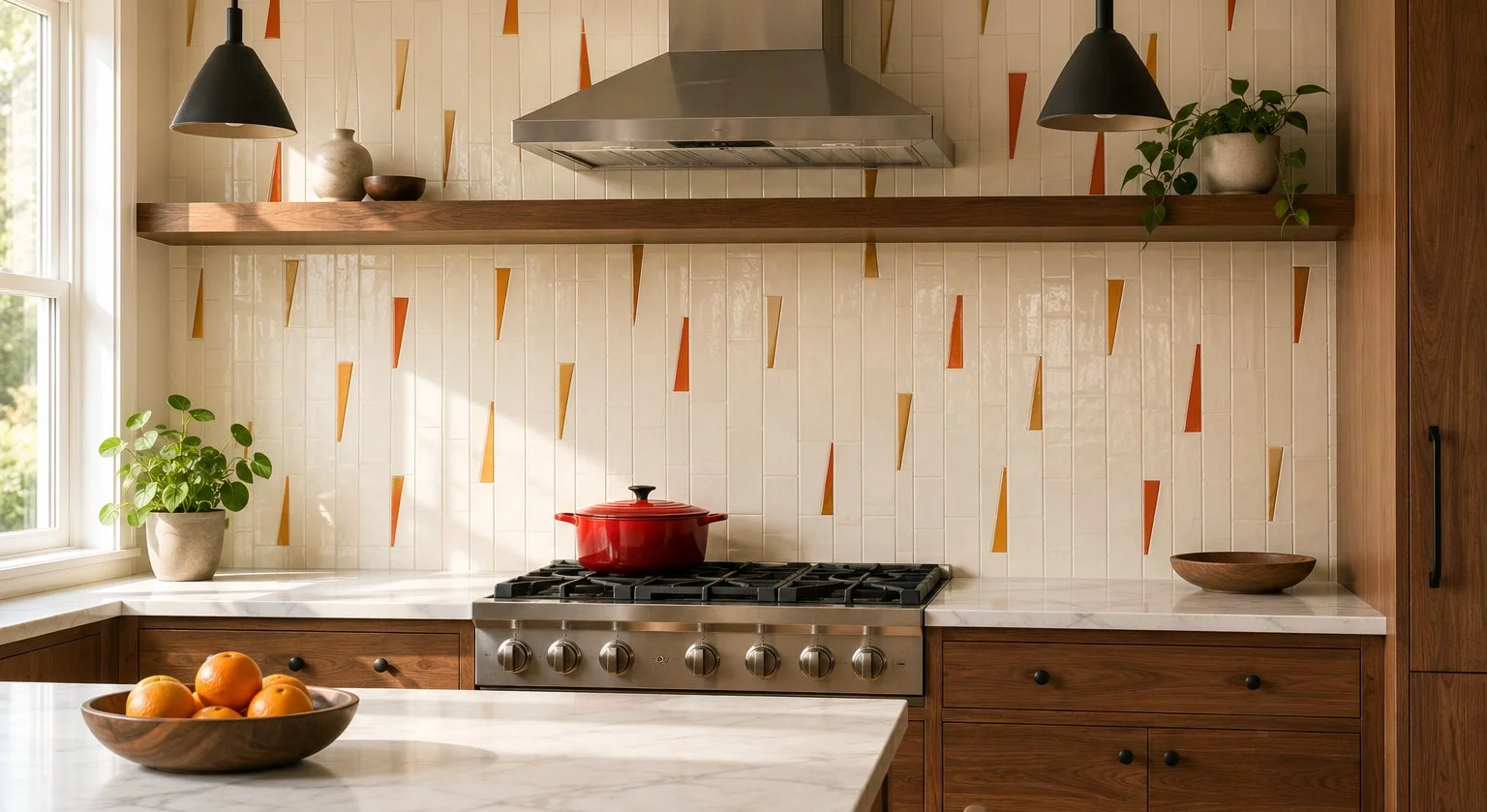
Nobody quotes a backsplash by the tile. They quote it by the angle of the cut and a wall that needs a diagonal at every single edge costs close to double the same wall laid straight. So before any of the pretty stuff, here’s what each of these nine kitchens is asking a tile setter to do.
| Tile and layout | Extra tile to order | What it does to the labor |
|---|---|---|
| Straight or stacked ceramic | 10% | Baseline |
| Herringbone, machine-made tile | 15 to 20% | About 1.5 to 2x the baseline hours |
| Herringbone, handmade glazed | 20 to 25% | Higher again. Some setters price walls at over twice baseline |
| Handmade zellige, laid straight | 15% minimum | Slow. Needs sorting and blending on site before anything goes up |
| Patterned cement tile | 10 to 15% | Normal setting, plus sealing time before grout and again after |
| Mesh-backed finger mosaic | 10% | Quick across the field, fiddly at every cut edge |
| Scallop or fish scale | 15% | Curved perimeter cuts and the top row needs a plan |
Those numbers move a bid more than the price per square foot does and two of these kitchens stack the multipliers on top of each other.
The two herringbone kitchens are the expensive ones and it isn’t close
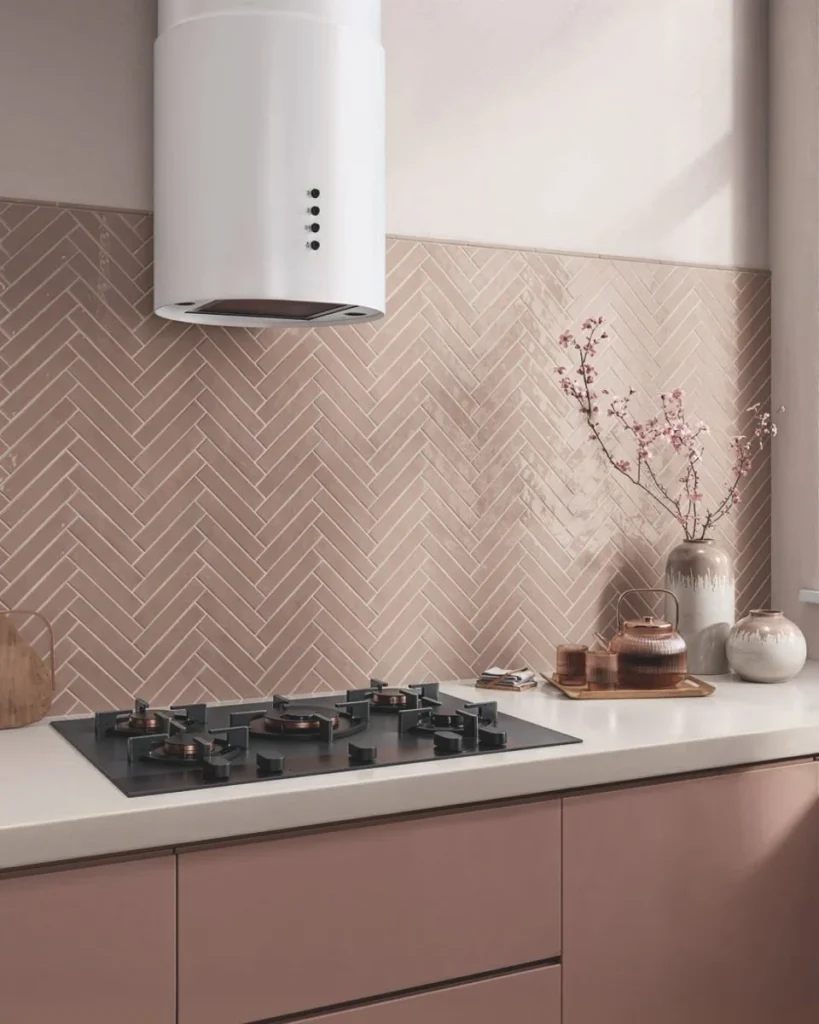
Straight lay wastes maybe five to ten percent of what you buy. Herringbone runs fifteen to twenty five and the reason is geometry rather than skill. Lay tile straight and you get straight cuts on two walls and trimmed widths on the other two. Turn the pattern forty five degrees and all four edges start producing triangular offcuts, every one of them a shape that fits nowhere else on the wall, so it goes in the bin. Roughly double the awkward cuts and each one is marked and measured individually because the angle shifts row by row along the perimeter.
Labor moves with it. Setters who price this honestly put herringbone walls at somewhere between double and two and a bit times their straight lay rate and even the thinset goes up ten to fifteen percent because of how the angular spread works. There’s a contractor writing about pricing who describes quoting a sixty square foot herringbone backsplash at his straight lay rate plus fifteen percent, then spending four days on it and clearing about eleven dollars an hour. That story gets retold in the trade a lot.
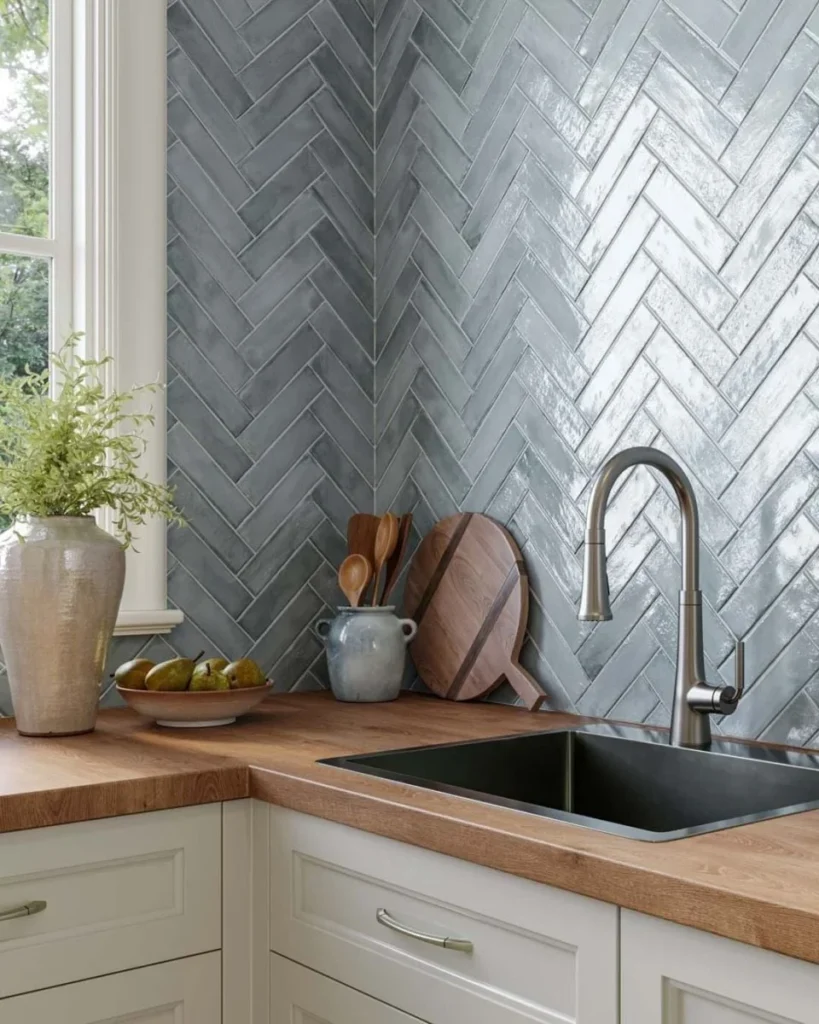
Now look at what the second one is doing. That’s handmade glazed tile, the kind with the pooled glaze and the uneven color from piece to piece and it’s laid in herringbone. Two cost multipliers on the same wall.
Handmade glazed tile comes with it’s own overage rule before the pattern is even considered. Suppliers ask for 15% minimum, sometimes twenty to twenty five if you want a more uniform look, because roughly fifteen to twenty percent of an authentic batch arrives with chips, pits or edge damage that’s considered part of the material rather than a defect. Boxes have to be opened together and blended, the whole run dry-laid on the floor first so the color variation spreads evenly instead of collecting in one corner and some installers soak the tiles beforehand so the dry clay doesn’t pull moisture out of the adhesive. None of that is the tile setter being precious. Skip it and you get a wall with a pale patch in the middle.
So does it still make sense? If you want handmade tile, lay it straight and spend the saved labor on better tile. The variation is doing the work in that material. The pattern is just adding cuts on top of a surface that was already interesting.
One more thing about handmade glazed tile near a range. It develops crazing, those fine cracks across the glaze and that’s normal and part of the look, but it also means tomato sauce and hot oil have somewhere to go. Suppliers also say to keep it away from ranges that vent hot air straight out the back onto the wall.
The under-cabinet lights will show you every high corner
Handmade tile doesn’t sit perfectly flush. Corners stand slightly proud of their neighbors, which is called lippage and the tile industry’s own standard for large format work caps allowable lippage at 1/32 of an inch because of how visible it becomes.
Visible under what, though. That’s the part people miss when they’re choosing in a showroom under flat overhead light. Lippage shows worst under raking light, meaning light traveling nearly parallel to the surface and an LED strip tucked under a wall cabinet three inches off the backsplash is about the most raking light you can install in a house. Every high corner throws a small shadow down the wall. In a showroom it’s invisible. In your kitchen at six in the evening it’s a texture you didn’t order.
Not saying don’t do it. Saying pick one, the handmade tile or the under-cabinet strip or accept that the two together will look like a hand-laid wall rather than a flat one, which some people want and some people find they hate about four days after the scaffold comes down.
The mid-century kitchen is the best of these nine
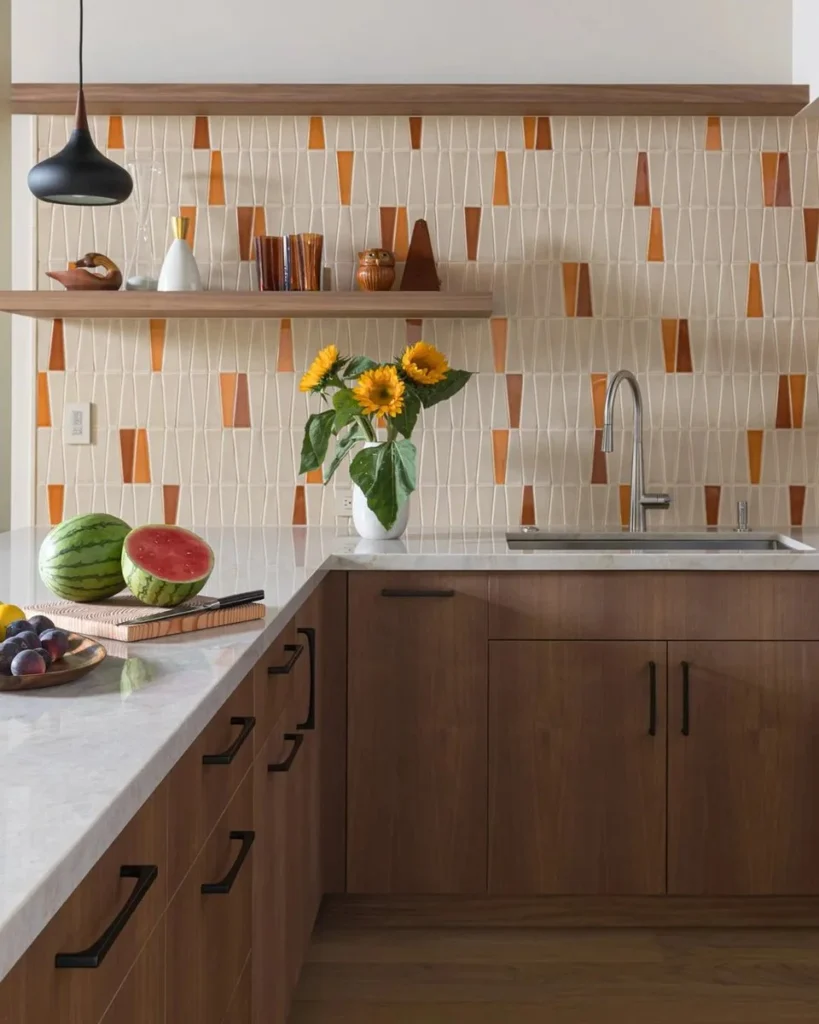
Sunflowers, a watermelon, a small ceramic owl. Somebody styled this within an inch of it’s life and it still works.
Cream field tile with orange and amber wedges dropped into it, walnut cabinets, white marble, matte black hardware. What makes it work is restraint about where the pattern stops. The tile runs the full wall and then a plain walnut shelf cuts straight across it and instead of fighting the pattern that shelf gives your eye a horizontal to rest on.
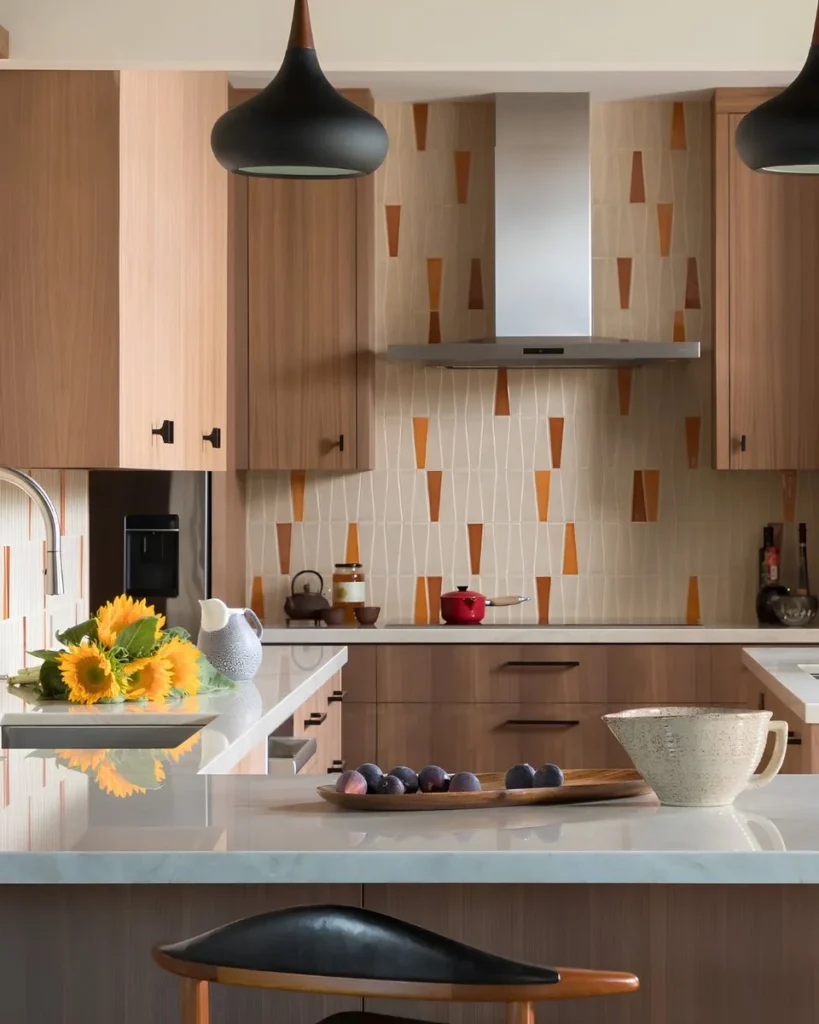
Worth knowing if you copy this: a pattern with scattered accent pieces has to be dry-laid before anything is set, because the accents need to miss the outlets and land somewhere sensible at the wall ends. And that floating shelf is bolted through the finished tile, which means drilling glazed ceramic with a diamond bit, slowly, with water and nobody enjoys doing it. Mount the cleats first and tile around them if the design allows.
The wedges are set at slightly different angles across the wall in a way I can’t work out. It might be four or five different tile designs mixed at random or one tile rotated. I stared at it for a while and gave up.
Cement tile means sealer before the grout, not after
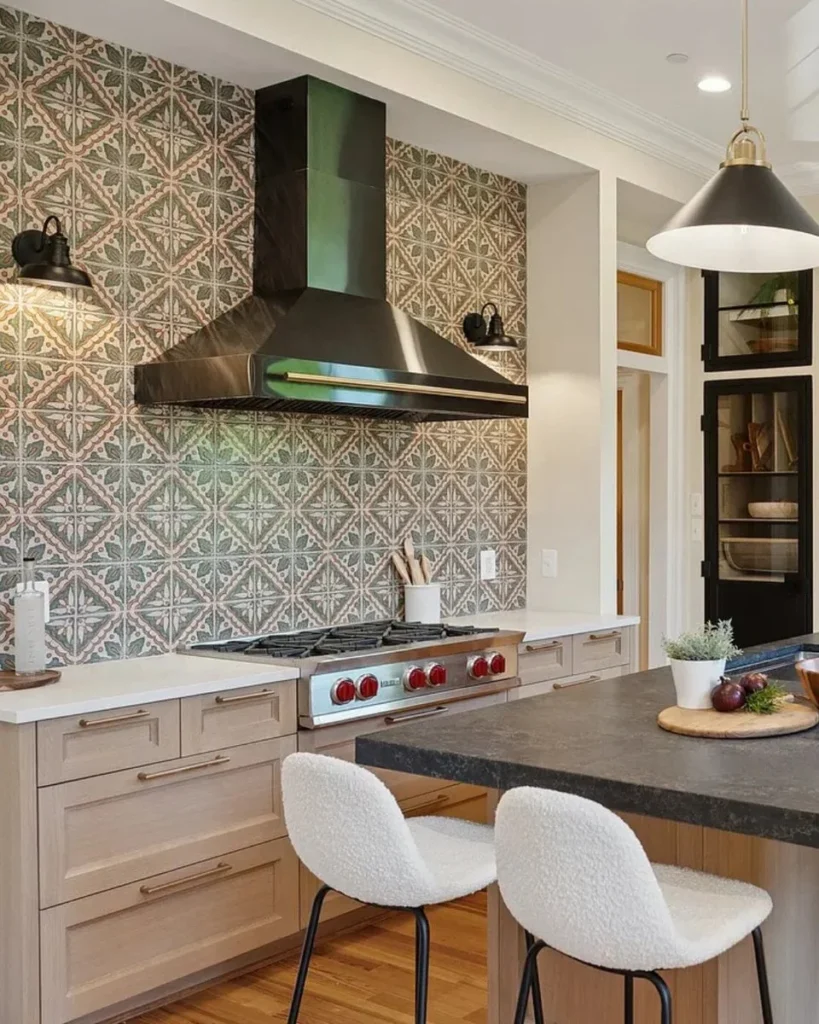
Two small wall sconces mounted right onto the pattern, which takes some nerve.
Encaustic cement tile is pigmented cement pressed one piece at a time and it’s porous in a way glazed ceramic simply isn’t. The order of operations is the thing people get wrong:
- Seal the tile with a penetrating sealer before it goes anywhere near grout or the grout pigment shadows the face and you can’t get it back
- Set, then grout with a narrow joint in a light color
- Seal again after grouting
- Reseal every two to three years on a wall, which is less often than a floor because a backsplash never gets walked on
After that it’s pH-neutral cleaner only. No bleach, no vinegar, nothing acidic and if oil does get in, the fix is a baking soda poultice left on overnight rather than scrubbing. Cement tile also runs thicker than ceramic, around five eighths of an inch, so outlet boxes need extending and the edge trim has to suit the depth. Cheap to fix at rough-in stage. Annoying to fix afterward.
The green and pink pattern behind that range is doing something clever, which is that the repeat is busy enough to hide the seam between tiles entirely, so the wall reads as wallpaper rather than as tile. Whether you want your range wall reading as wallpaper is a separate question.
Scallops look simple until you reach the top row
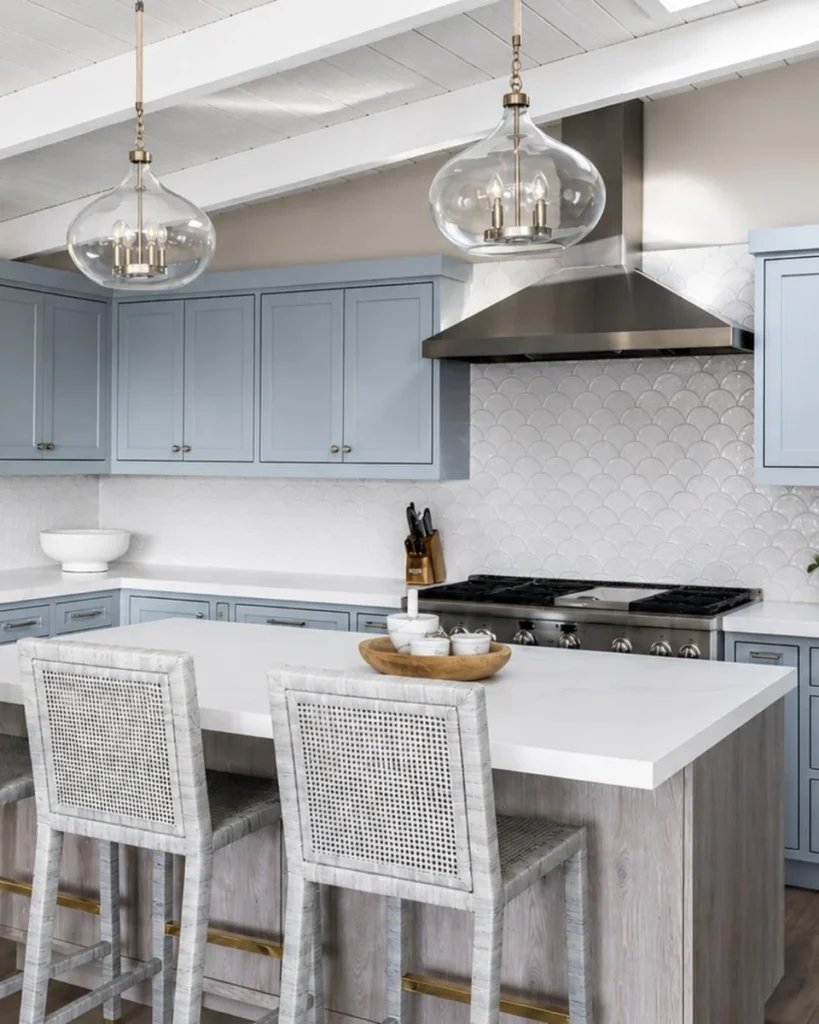
Pale blue shaker, white scallops and a hood the same finish as the range. Nothing in this kitchen is fighting anything else.
Fish scale tile arrives on mesh sheets and goes up fast across the open field. The edges are the problem. Every perimeter cut is a curve, the top of the run either needs a trim piece or a deliberately straight-cut row and the sheets have to be nudged so the scallop rhythm carries across the joins without a stutter.
That kitchen handles it by running the tile to the underside of the cabinets and letting the hood surround interrupt it, so there’s barely any exposed top edge to resolve. Sensible.
Arches make every cut a curve
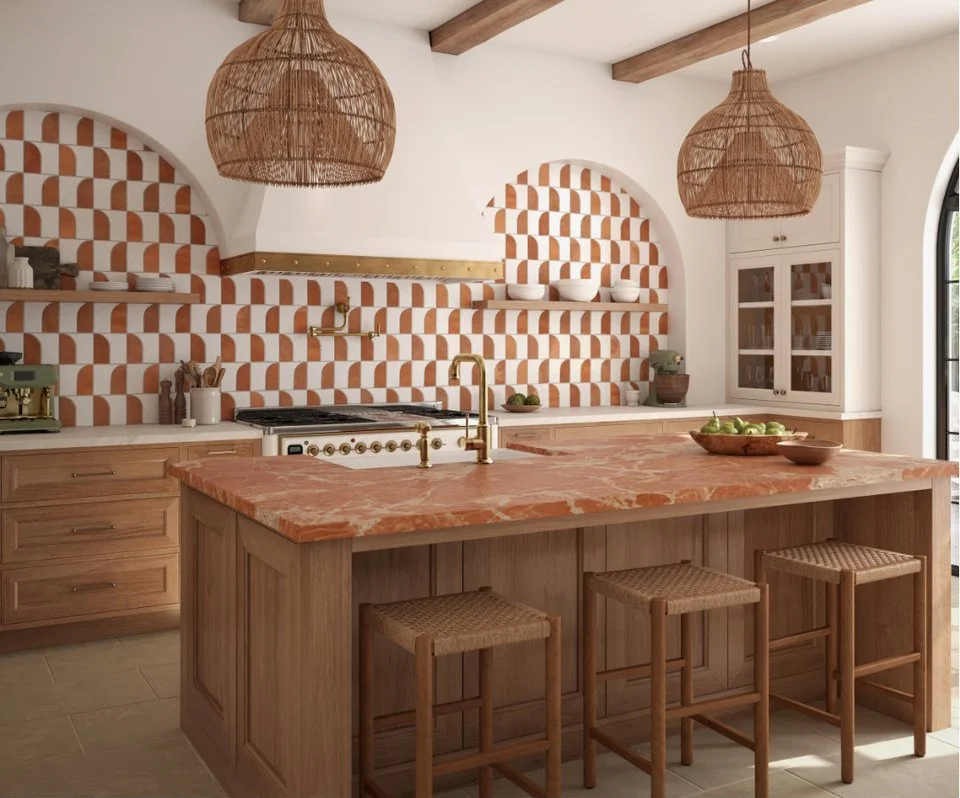
The island is a red marble I’ve not seen used this way before and it’s carrying the room more than the tile is.
Those two arched niches are the expensive part, not the half-moon tile. An arch means the tile inside it gets scribed to a curve, piece by piece, each one different and there’s no formula. The setter works off a template and trims until it fits.
Then there’s the pattern to think about. Half-moon tiles read as a directional repeat, so where the arch cuts through them the shapes get sliced at odd points and a good layout puts the full shapes where the eye lands and the butchered ones at the springing point where the curve starts. Hard to judge from a photograph whether that happened here.
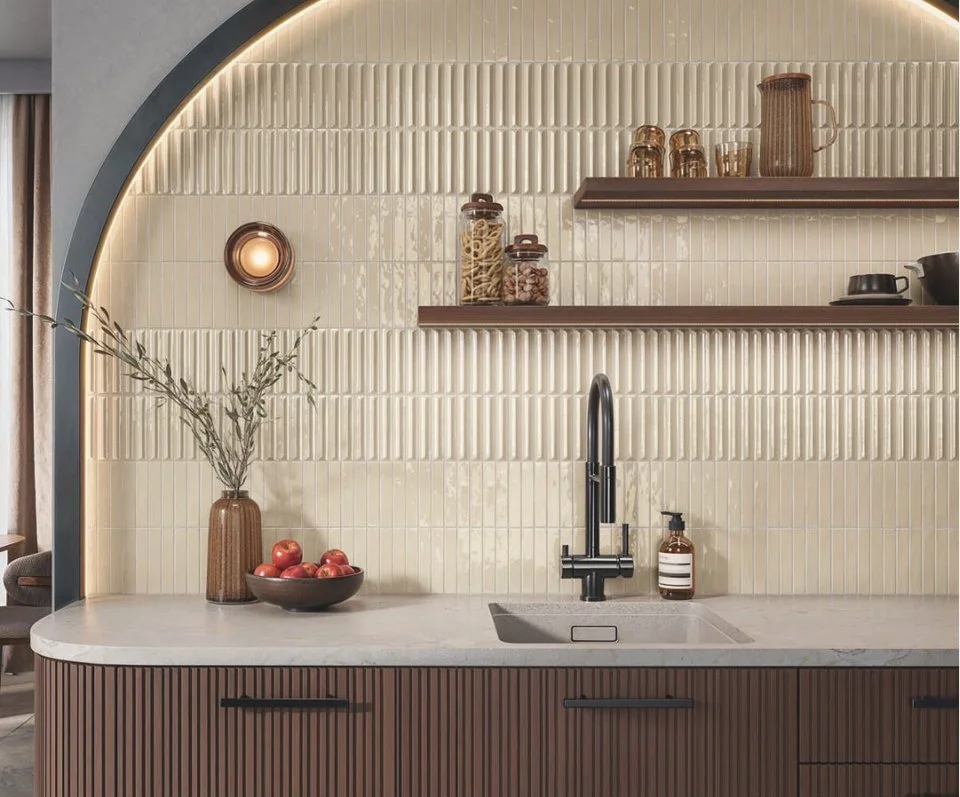
The light strip is buried in the arch reveal so you see the glow and not the source.
The fluted alcove is the same problem with a harder edge, because that arch has a dark trim running around it and trim like that has to be either mitered or bent to the radius. I genuinely don’t know which they did here.
Finger tile and the one decision that changes everything
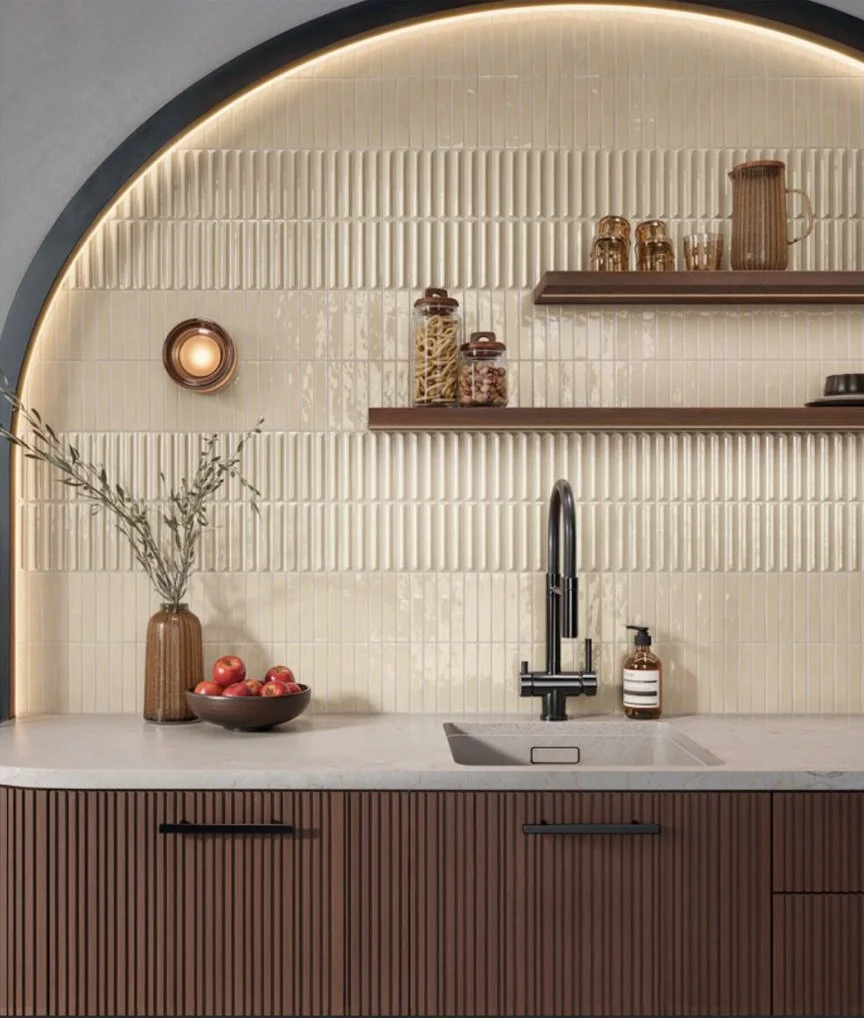
Finger tile, kit kat tile, whatever your supplier calls it, is usually around 15 by 98mm and comes mesh-backed in sheets. Straightforward to install across a field. Lots of grout line per square foot though, which is why epoxy grout keeps getting recommended for it, since epoxy has no cement in it and doesn’t need sealing or absorb grease.
Grout color is where this tile is won or lost. Match the grout to the tile and the wall becomes one continuous ribbed texture, which is what’s happening in that cream alcove. Contrast it and every finger reads separately and the wall turns graphic and busy. Same tile, two completely different rooms and it costs the same either way.
Most of these kitchens will look fine in five years. The ones that won’t are the ones where somebody chose handmade tile for the imperfection and then hired a setter who quoted it like machine-made ceramic and worked at that speed to protect the margin. You can spot that job from across the room and by then the only fix is taking the wall off.