


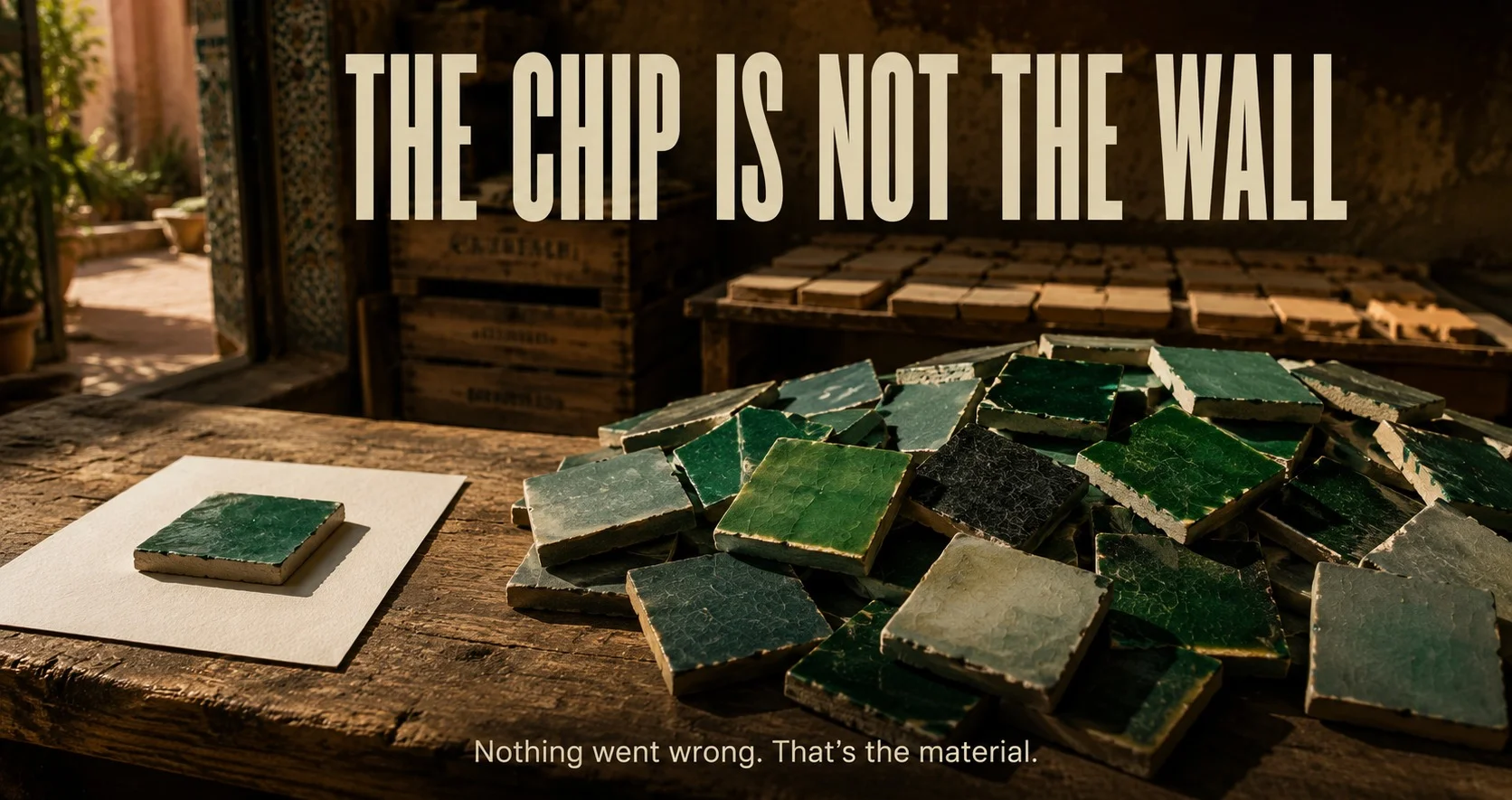
The complaint arrives in the same shape almost every time. Someone orders zellige for a kitchen wall, picks the color off a single chip, waits eight weeks for the crate, and then stands in front of the finished thing convinced the supplier sent damaged stock. Colors shifting from tile to tile. Edges that wobble. A surface that catches light in patches instead of lying flat and even.
Nothing went wrong. That is zellige behaving normally, and the mismatch sits almost entirely in how it gets sold rather than how it gets made.
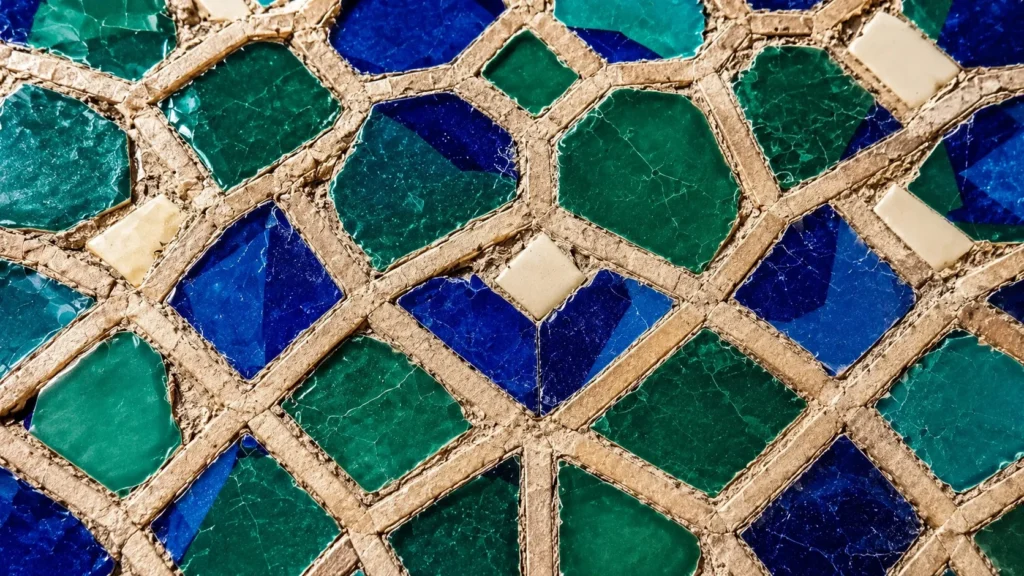
Porcelain gets manufactured. Zellige gets produced by hand in a sequence that resists standardization at every stage and buyers who treat the two the same way end up disappointed for reasons that have nothing to do with the tile.
What zellige actually is?
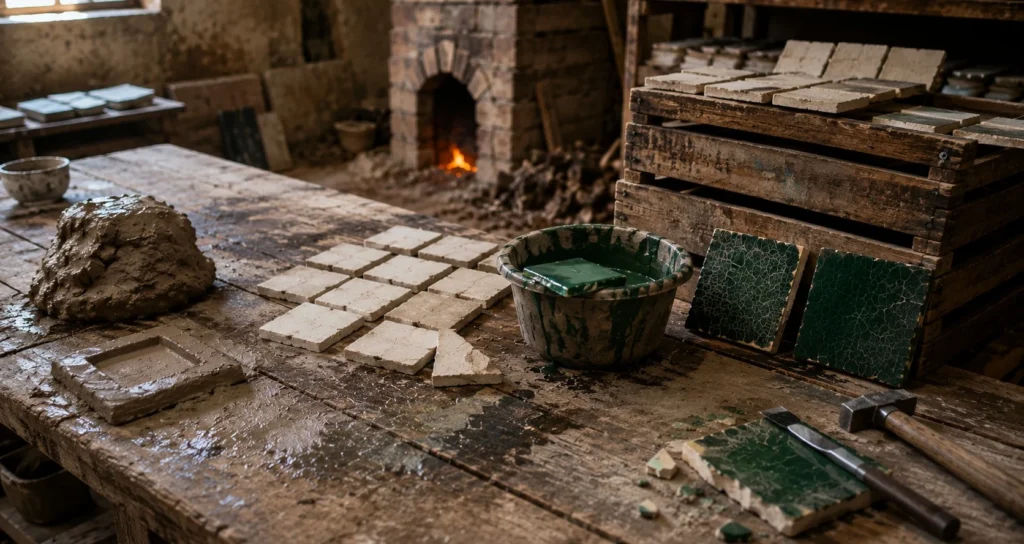
Clay from the Fez region, wet-shaped into rough squares, dried in sun, fired in kilns fueled with olive pits and wood, glazed, fired again, then chiselled to size by hand. That last step matters more than people expect. In the traditional process the fired tile gets trimmed on a bevel by a craftsman with a hammer, which is why the edges are never quite square and why the finished field has that slight ripple to it.
The kiln does most of the color work, and it does it unevenly. Temperature varies across a load. Tiles nearer the heat come out different from tiles at the edge. Glaze pools thicker in some depressions and thinner across raised spots, so a single tile can read light in one corner and saturated in another. Nobody is correcting for this. Correcting for it would produce something else entirely.
The crazing is worth its own note. Those hairline fractures running through the glaze surface happen because the glaze and the clay body cool at different rates and the glaze ends up under tension. On a mass-produced tile that would be a rejection. Here it is a feature that most buyers eventually decide they like, though usually after a period of mild panic.
Why the sample chip misleads?
A sample is one tile. The wall is four hundred. Judging a variable material from a single unit of it is a bit like picking a stone countertop from a two-inch cutoff, except worse, because stone at least varies predictably within a slab.
What you get from a sample is the color family. Not the color. If your chip is a mid-green, the wall will contain pieces noticeably paler and pieces noticeably deeper, some almost teal, a few nearly grey where the glaze went thin. That spread is the product.
I would push suppliers harder on this than most of them push themselves. Anyone selling zellige off a single chip without saying plainly that the installed result will not look like the chip is setting the customer up. Ask for photographs of completed installations in the same color, or several tiles rather than one, and if a vendor cannot produce either, that tells you something about how much of their stock they have actually seen.
Ordering: the overage rule breaks here
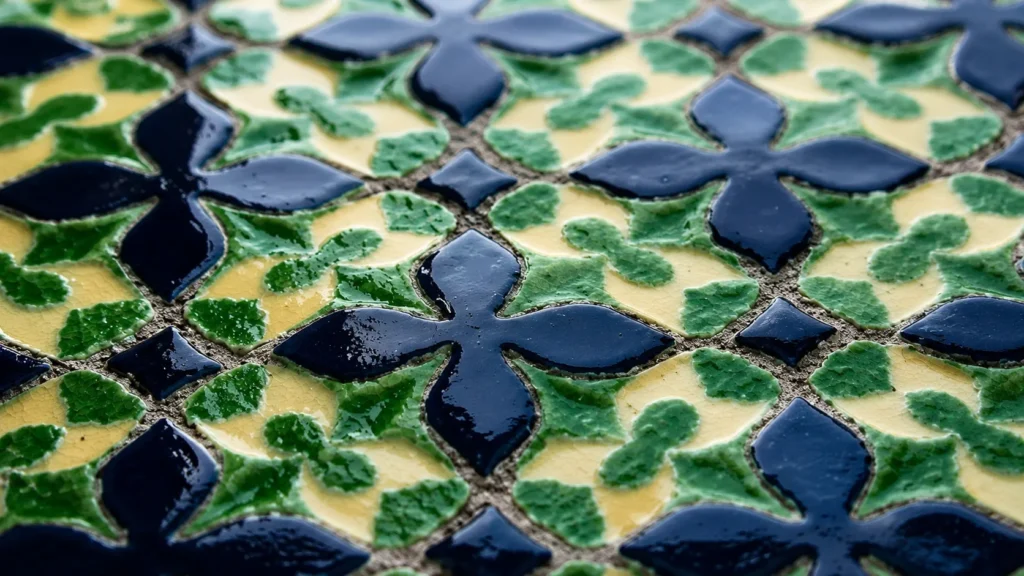
Standard tile practice is to order ten to fifteen percent above measured area for cuts and breakage. For zellige that figure is too low, and the reasons stack.
- Breakage in transit and handling runs higher. Hand-formed tiles vary in thickness and density, so they crack under stress that machine-pressed tiles shrug off.
- Culling on site is real. Installers reject pieces that are badly warped or too far off the color range. On some batches that is a small handful. On others it is meaningful.
- Lot matching is not reliable. Order more three months later and you will get a different firing. Not slightly different. Visibly different.
- Cuts waste more. Irregular edges mean the tiler is working around each piece rather than through a stack of identical ones.
How much should you actually order? Twenty to twenty-five percent over measured square footage, and closer to twenty-five if the installation is a single continuous field where a later patch would be obvious. That extra crate is cheap next to the cost of stopping mid-job.
Keep the leftovers. Not in a damp garage, but boxed and indoors, because the tile you break in year four is not replaceable from the same lot.
Grout width and the argument about it
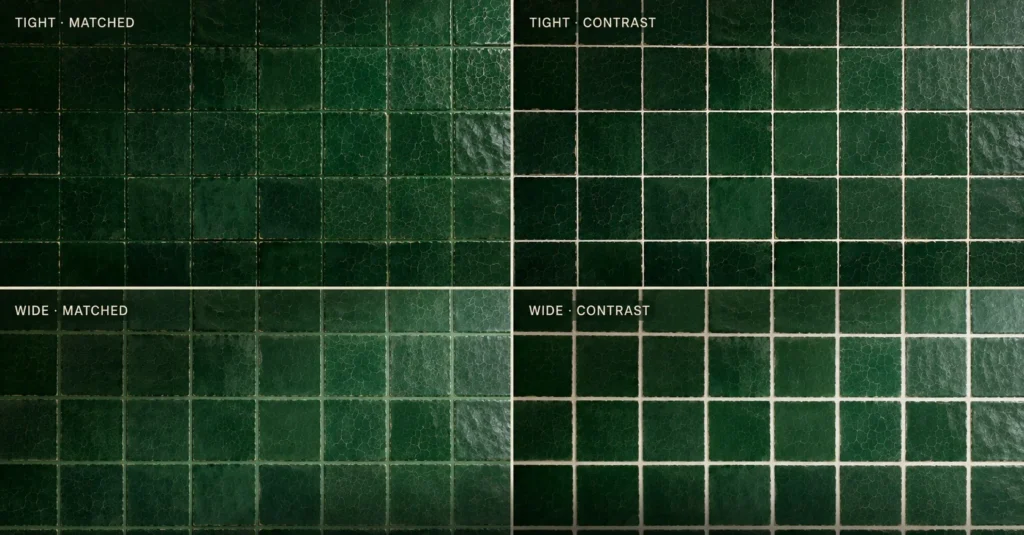
Zellige gets set tight, traditionally with joints of a millimetre or two, so the field reads as a continuous surface rather than a grid. That is the look people are buying, mostly without knowing they are buying it.
The problem is that tight joints on irregular tile demand real skill. Edges are not straight, thickness varies, and the tiler is constantly making judgment calls about how to nest one piece against the next. Rushing it produces sharp lippage where a raised edge catches the eye and, in a shower, catches water.
Plenty of installers will push for a wider joint. Three or four millimetres makes the work considerably faster and hides the size inconsistency. It also makes the wall look like ordinary tile. I do not think that trade is worth it, but it should be a conversation you have deliberately rather than a decision your tiler makes alone on the first morning.
Grout color decides how much of the variation reads. Matched grout pulls the field together and softens the whole surface. Contrasting grout, usually white or a pale grey, draws every outline and turns the wall graphic. Both work. They produce entirely different rooms.
Telling real zellige from the lookalikes
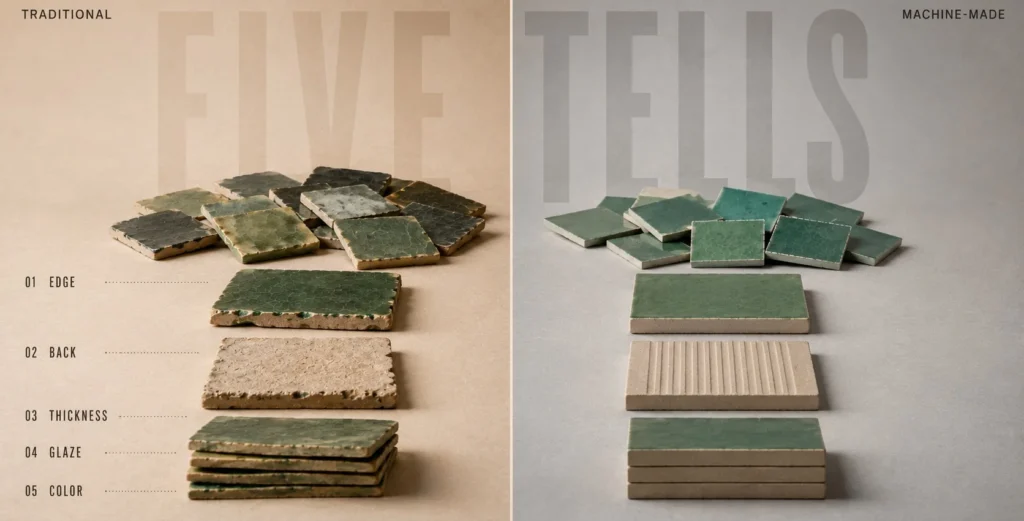
The market has filled with machine-made tiles marketed as zellige-style or zellige-inspired, and some are decent products in their own right. They are not the same thing and they should not cost the same.
| Signal | Traditional zellige | Machine-made lookalike |
|---|---|---|
| Edges | Chiselled, bevelled, inconsistent | Uniform, cleanly cut |
| Thickness | Varies piece to piece | Consistent |
| Back of tile | Rough, sometimes marked by hand | Ribbed or stamped, identical |
| Color range in a box | Wide, unpredictable | Narrow, controlled variation |
| Repeat patterns | None | Detectable across a large enough field |
That last row is the giveaway. Manufacturers simulate variation by producing a set number of face designs and mixing them. Lay enough of it and the same face reappears. Real zellige has no repeat because there is no master to repeat from.
Where it belongs and where it struggles?
Kitchen backsplashes and bathroom walls are the obvious uses and they suit the material well. Fireplace surrounds work. Shower walls work with a competent installer and proper waterproofing behind them.
Floors are a harder call. The tile can take it in low-traffic areas, but the uneven surface and the crazing both become liabilities underfoot, and the maintenance burden climbs. Kitchen floors in particular I would avoid, since the crazing traps oil and staining shows.
Countertops come up occasionally and I would talk anyone out of it. Zellige is not a work surface.
Zellige has been fashionable long enough now that a fair number of people are buying it because it photographs well, which is a bad reason and produces a lot of regret when the crate arrives and the crazing looks like damage. The material rewards people who wanted an uneven handmade surface in the first place and punishes people who wanted a uniform one with character. Those are not the same customer, and the industry has been sloppy about telling them apart