


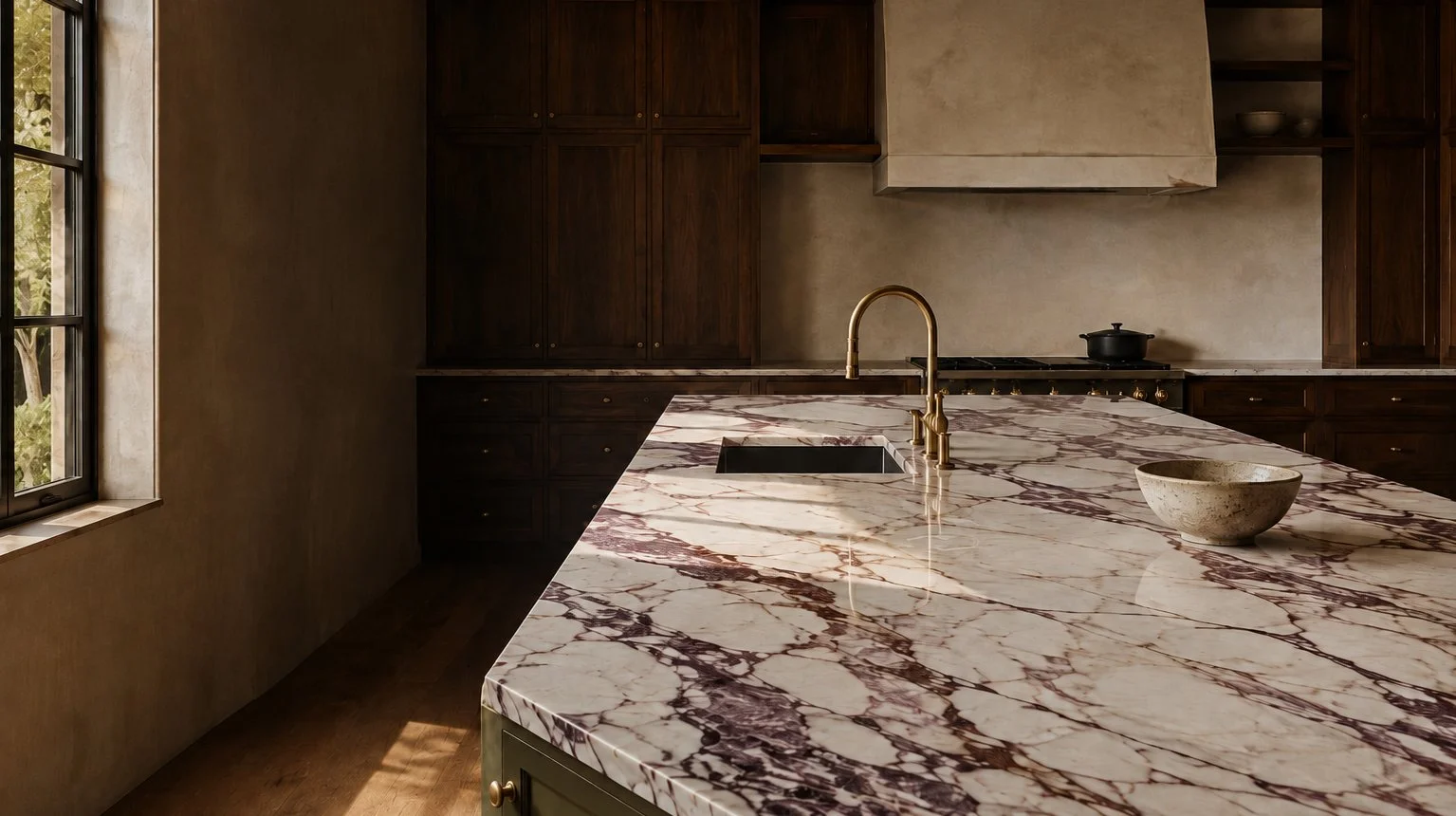
A slab standing upright in a stone yard is about the size of a door, lit from the side, with a spotlight aimed at its best section. The same stone on your island lies flat under overhead light and covers something like forty square feet. People fall in love with the first object and then live with the second one, which explains most of the regret in this category.
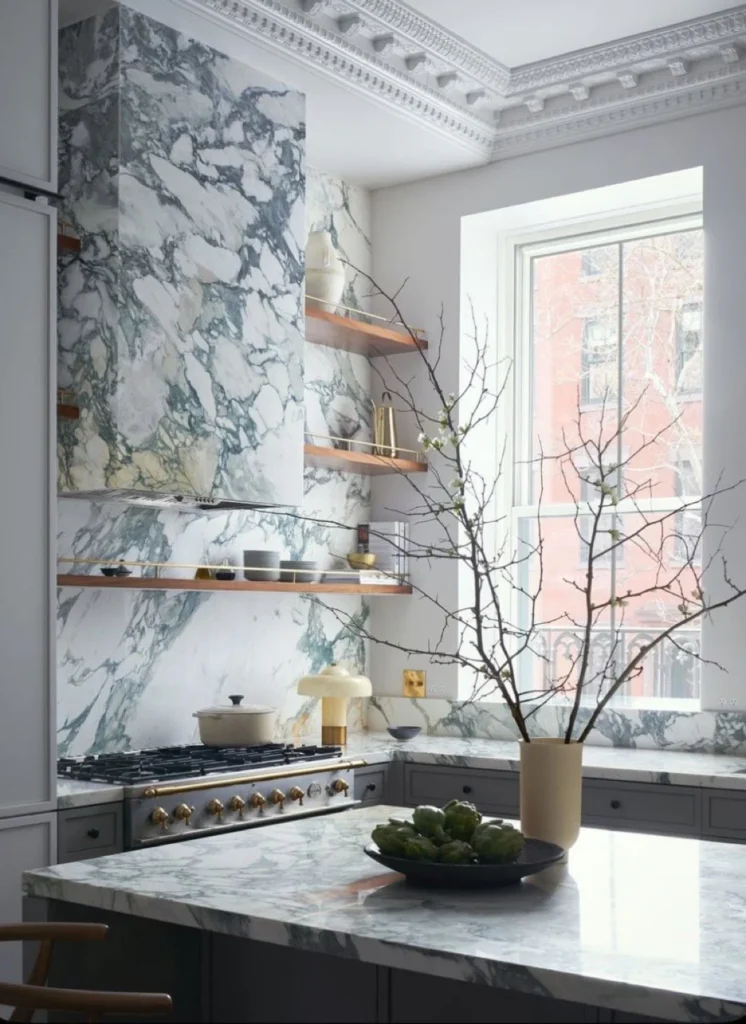
Colored marble is where kitchen stone has gone. Burgundy-veined slabs on islands. Deep green running up behind ranges. Wine and violet where three years ago there would have been soft gray on white. The stones themselves are worth knowing by name, because the price gap between them is enormous and the maintenance problem gets worse as the color gets richer.
Calacatta Viola And Verde Alpi Are The Two Names Driving This
Calacatta Viola is the one everybody wants. It is a rare Italian marble carrying bold purple, burgundy and wine-colored veining across a creamy white ground, quarried in the Carrara region. The coloring comes from minerals that were present in the limestone before it crystallized. It won best kitchen worktop at the 2025 Kitchen Awards, which is roughly when the wider rush began.
The pairing advice from designers keeps arriving in the same shape. Roundhouse’s Isabella Pacelli points to Calacatta Viola Monet as a softer variation. She suggests styling the stone against rich dark cabinetry and dark timbers, walnut in particular.
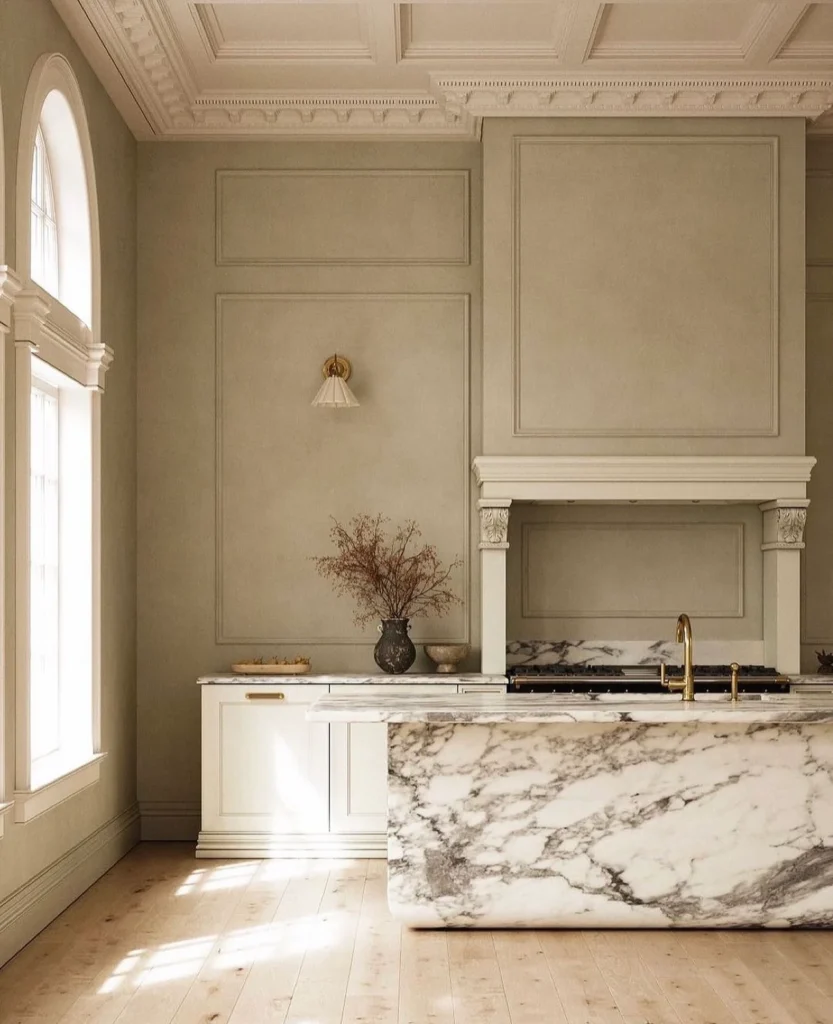
There is a second route that works as well and costs less to get right. A kitchen with a putty-green paneled wall, plain plaster hood surround, coffered ceiling and painted shaker cabinetry can wrap a single island in gray-violet marble and stop there. No pattern anywhere else in the room. The stone becomes the one object with movement in it. Flat color around it makes the veining look better than it would in a busier room.
Green is the other movement, quieter but climbing fast. Deep green surfaces in marble, quartzite and engineered stone are showing up in design-forward kitchens. Green remains a niche pick, though it is growing faster than any other non-neutral countertop color. Verde Alpi is the name to know, an Italian stone running emerald through forest green with white veining in a brecciated pattern.
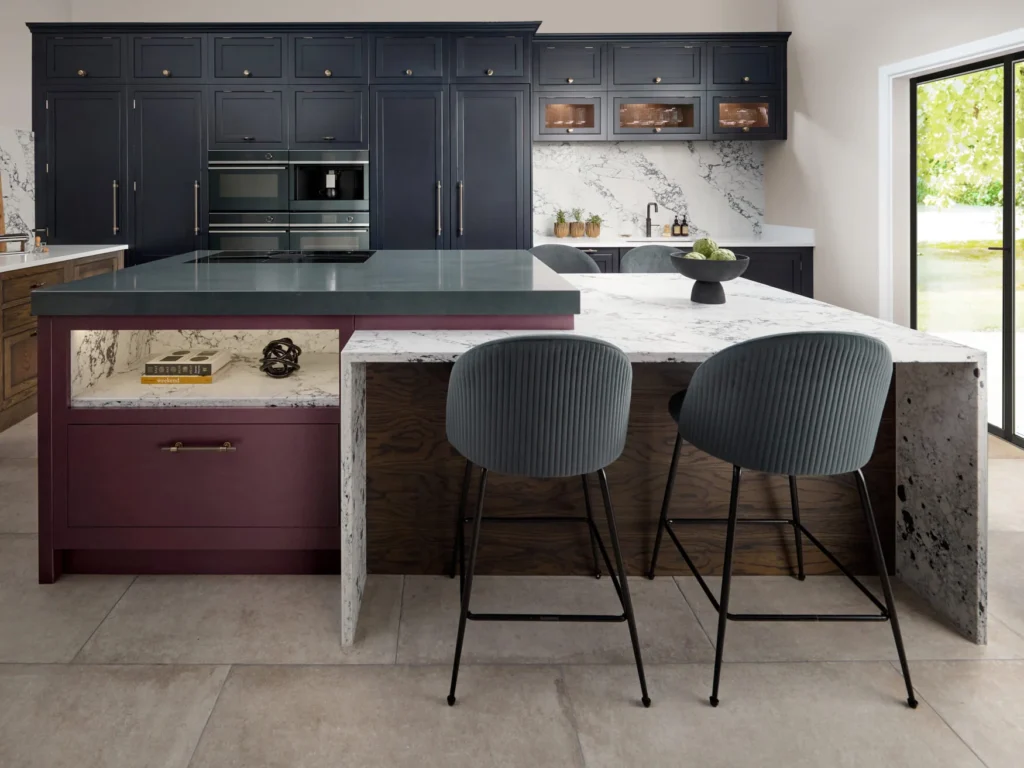
Multi-stone kitchens are appearing too. They are harder than they look. One recent build runs navy cabinets to the ceiling, a white marble splash, a burgundy-painted island carcass, a green-gray slab over the cooking island and a speckled stone panel on the seating end. Four colors, three different stones. It holds together because the marble is confined to two zones and every other surface is solid color, giving the eye somewhere to rest. Put that white marble on every counter in the room and the whole arrangement falls apart.
For veining without the Carrara premium, Arabescato Vagli comes out of the Apuan Alps in Tuscany, a dense compact marble with stronger, straighter veining than its relatives. It costs less than Calacatta.
One Loud Stone Per Room Is The Limit
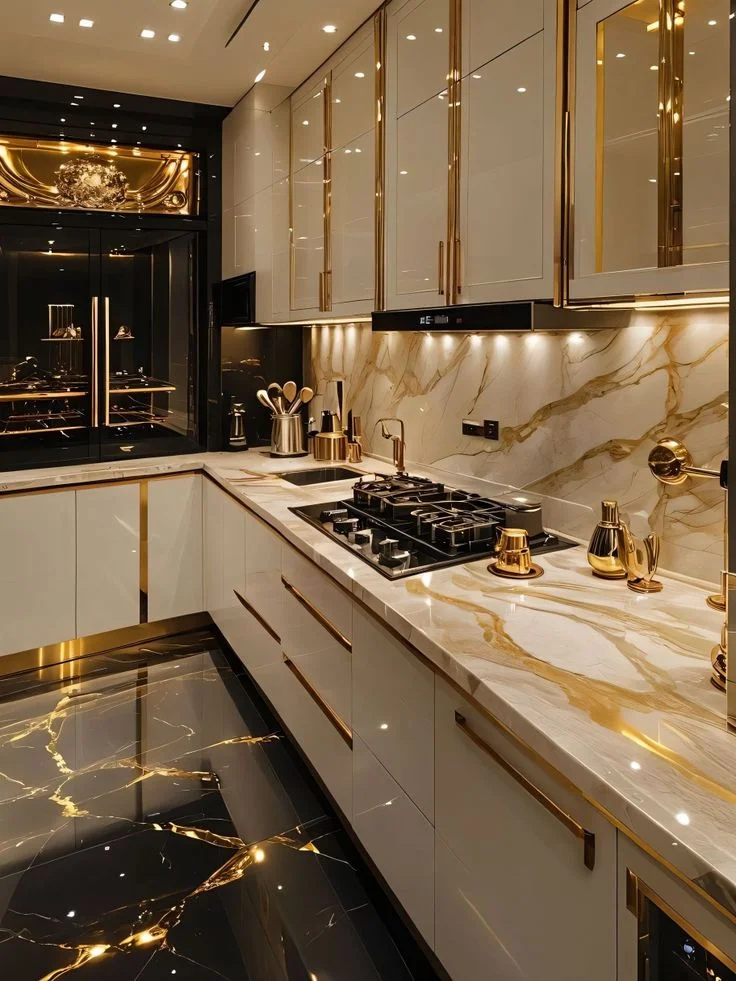
The expensive failure looks like this: gold-veined marble across the counters, the same stone taken full height up the backsplash, a black and gold marble floor underneath it, gold framing on every cabinet door. Gold fittings on the tap. Nothing in a room like that is at rest. The stone stops registering as stone and starts reading as wallpaper, which is a strange thing to pay two hundred dollars a square foot for.
Maria Killam calls this pattern allowance. Her warning about viola marble specifically is worth reading before anybody signs a quote. Her point is that the stone carries violet veining over a pink ground, so it suits people happy to decorate around plum, purple and burgundy indefinitely. Anyone expecting a versatile neutral should use restraint.
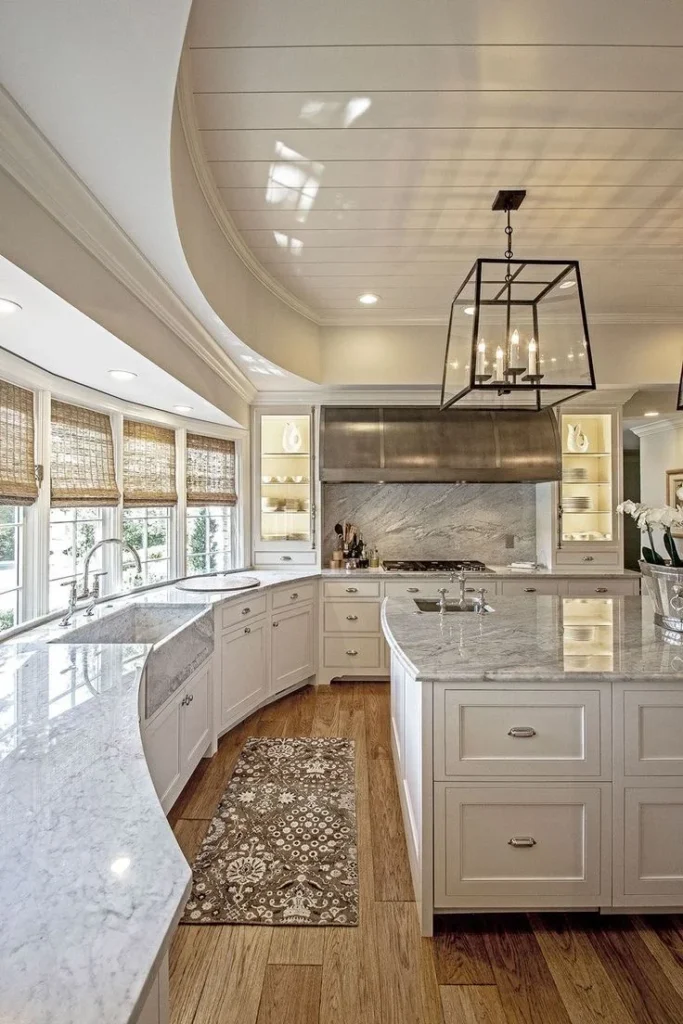
The opposite approach is a kitchen where the counters curve in a long arc around a bay window, the ceiling is curved shiplap, the hood is brushed steel and the stone is Carrara-family gray on white, which is about as quiet as marble gets. All the drama sits in the shape of the room. When the stone is calm you get to be loud with everything else. That trade is available at a third of the price of a statement slab.
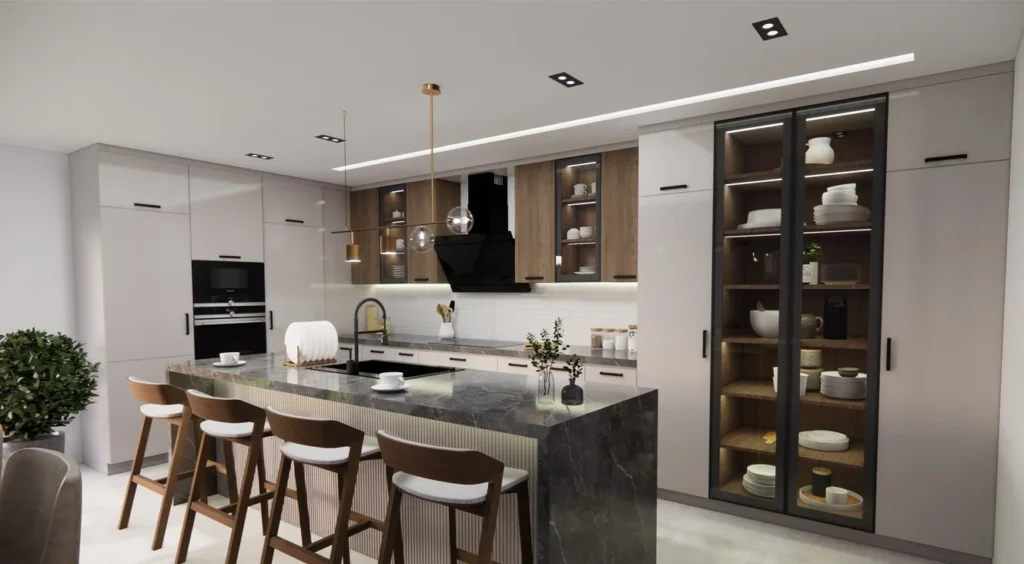
Dark stone plays by its own rules. A near-black marble island with a fluted base, sitting in a pale room with wood cabinetry and lit glass display units, works because it is the single dark mass in the space. It reads as furniture rather than as countertop. It also brings a problem nobody selling the slab will raise.
Etching Shows Up Worse On Colored Stone Than On White
Marble is calcium carbonate, so acid dissolves a microscopic layer of the surface on contact, leaving a dull lighter mark called an etch. Lemon, vinegar, wine, tomato, coffee and soda all do it. Sealing does not prevent any of that, because sealers block liquids from soaking in rather than stopping a surface reaction.
That last clause is the most useful thing in this article. Etching happens on the stone face, above where the sealer operates, so only avoiding acid prevents it and only mechanical restoration fixes it. Anyone telling you a good sealer handles etching is either wrong or counting on you not knowing.
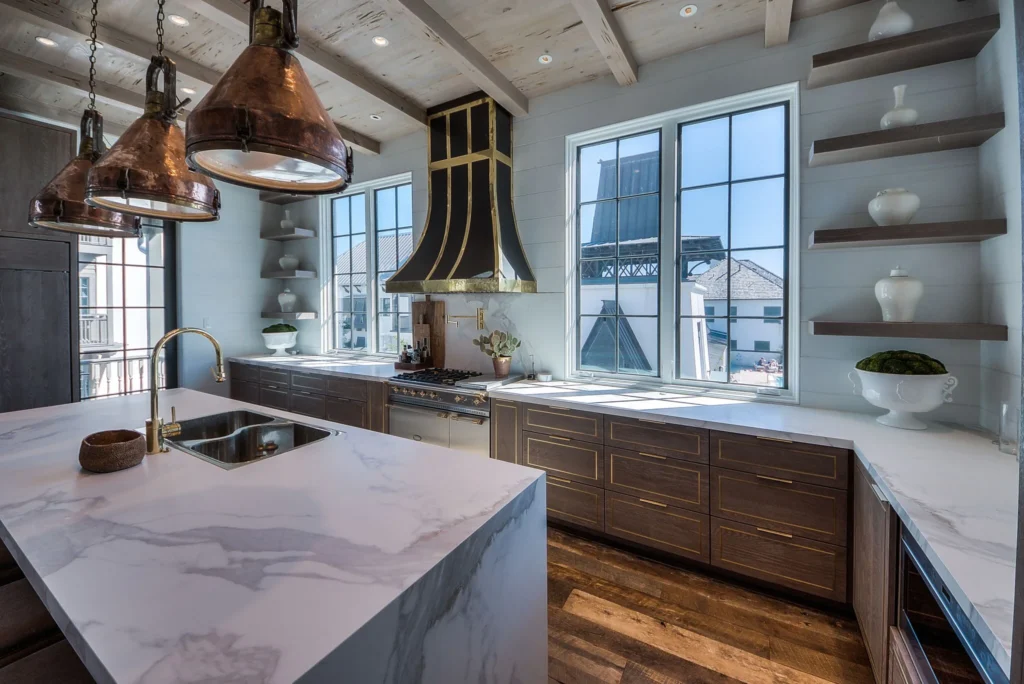
Now carry that onto a colored slab. An etch is a dull, lighter spot. On white marble a pale dull mark sits against a pale bright ground, so it hides in plain sight and half the time you only catch it with light raking across at an angle. On deep green or burgundy, that same pale mark has a dark ground to show against. The stone does not etch any more than white marble does. It just has nowhere to hide the damage.
Finish does the heavy lifting here. Honed marble is what most designers recommend for kitchen counters, because the chemical reaction is identical but a matte surface shows etch marks far less than a mirror polish. Honed stone is slightly more porous in exchange, so sealing matters more for stains even while doing nothing at all for acid.
The repair ladder is short when it goes wrong. Light etching can be polished out at home with marble polishing powder costing $10 to $20. Full professional restoration of a kitchen countertop generally runs $200 to $600.
The Fabrication Charges That Land After The Slab Price
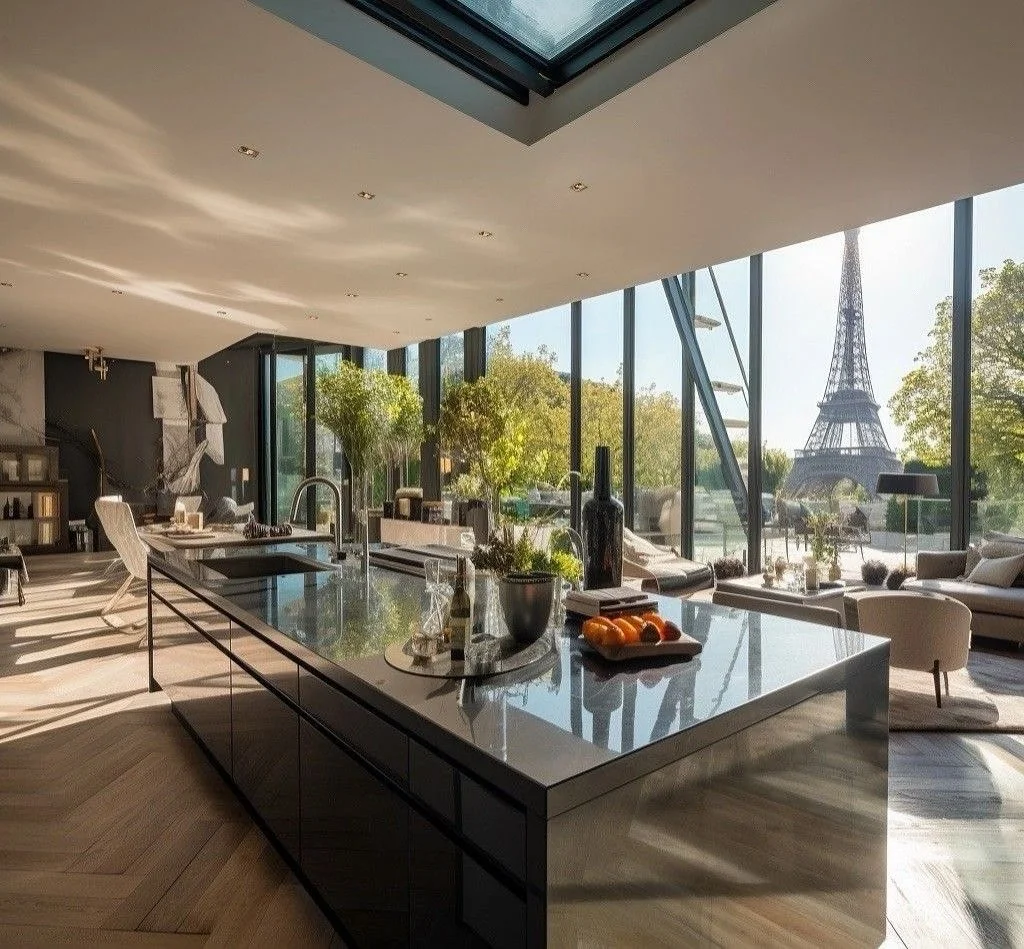
Square-foot pricing gets quoted as though it were the whole number. Marble runs $65 to $250 per square foot installed across the board, with common Carrara-family stone starting around $75 to $110 and premium Italian varieties reaching $130 to $200 and up. Genuinely rare material, Calacatta Viola included, sits at $150 to $300 plus per square foot installed.
Then the line items arrive:
- A waterfall end on an island is roughly six extra square feet of stone plus the miter work, adding $1,000 to $3,000 per side.
- Full-height slab backsplash gets charged as added square footage, generally $650 to $1,200.
- Sink cutouts run $150 to $350 each. Faucet holes are $50 to $80 apiece. A farmhouse sink and a gas cooktop quietly add several hundred dollars between them.
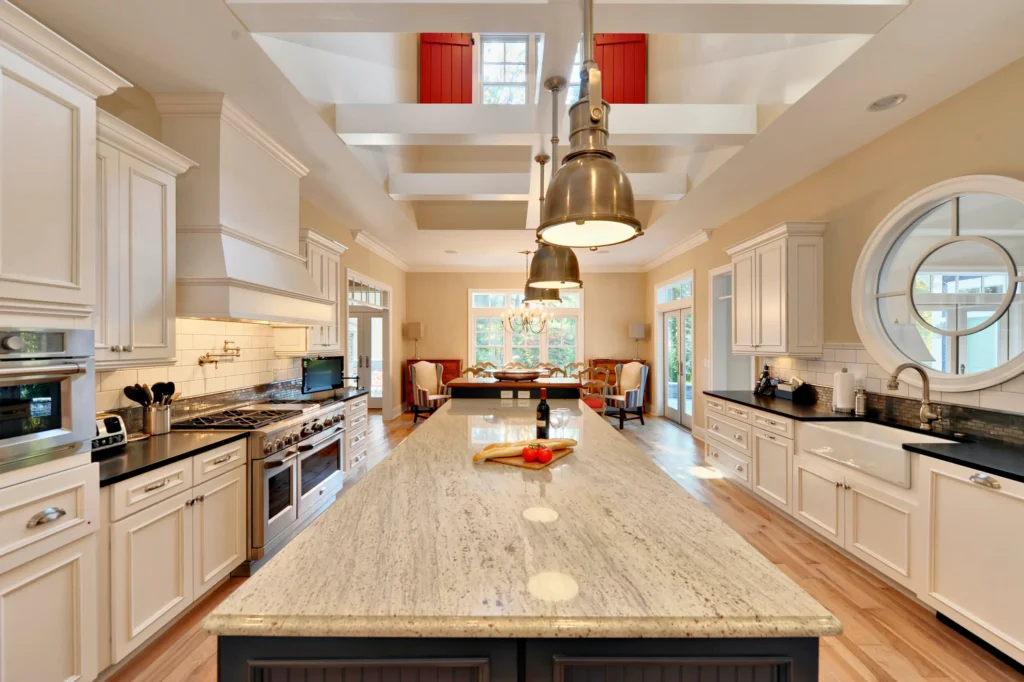
Bookmatching carries a cost that rarely gets quoted at all. Running a vein pattern continuously from counter to splash to hood means buying consecutive slabs cut from the same block and accepting more waste in the layout. That is a slab-yard conversation rather than a line on a spreadsheet. Worth having before you fall for one specific piece of stone that turns out to be the last of its block.
Which Kitchens Should Skip Marble Entirely
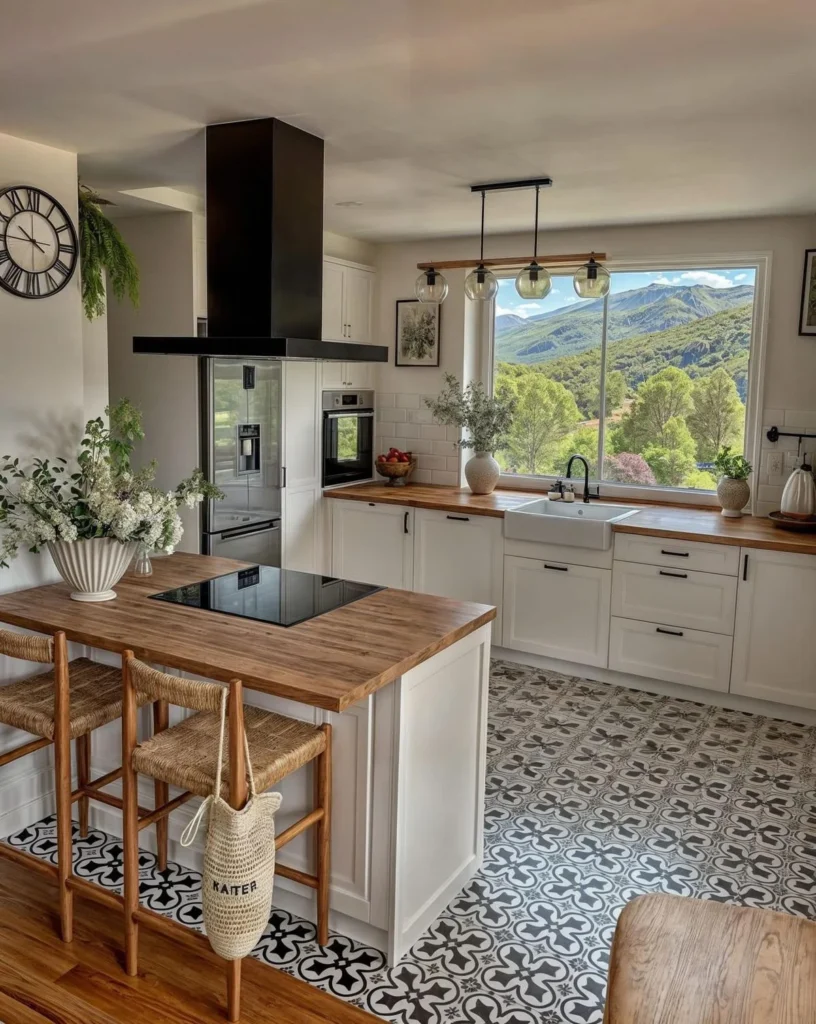
Some kitchens have already spent their attention budget. A white shaker room with butcher block counters, a black and white encaustic floor, a black island hood and a window filled with mountains does not need stone. It would be worse with it. The floor is doing the pattern work and the view is doing everything else. Marble is an optional conversation, which the marble industry would rather people forgot.
Two honest routes exist for anyone who wants the look without the chemistry. Quartzite sits at $70 to $200 per square foot installed and is far harder than marble, a 7 on the Mohs scale, so it shrugs off the acid problem while still giving you veining. Porcelain slabs printed with marble patterns run $60 to $100 installed and are non-porous plus etch-resistant. At normal viewing distance they are increasingly hard to tell apart.
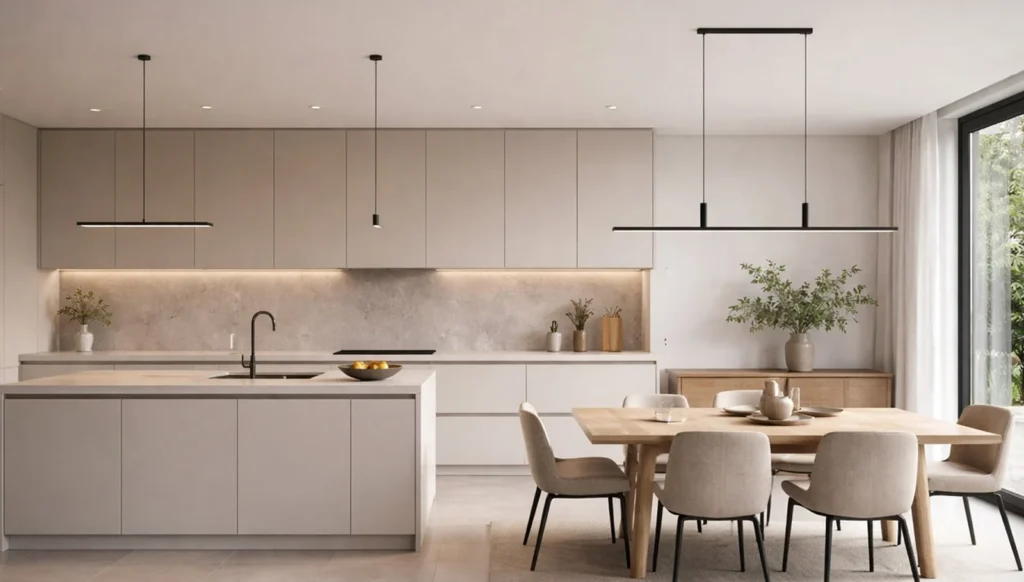
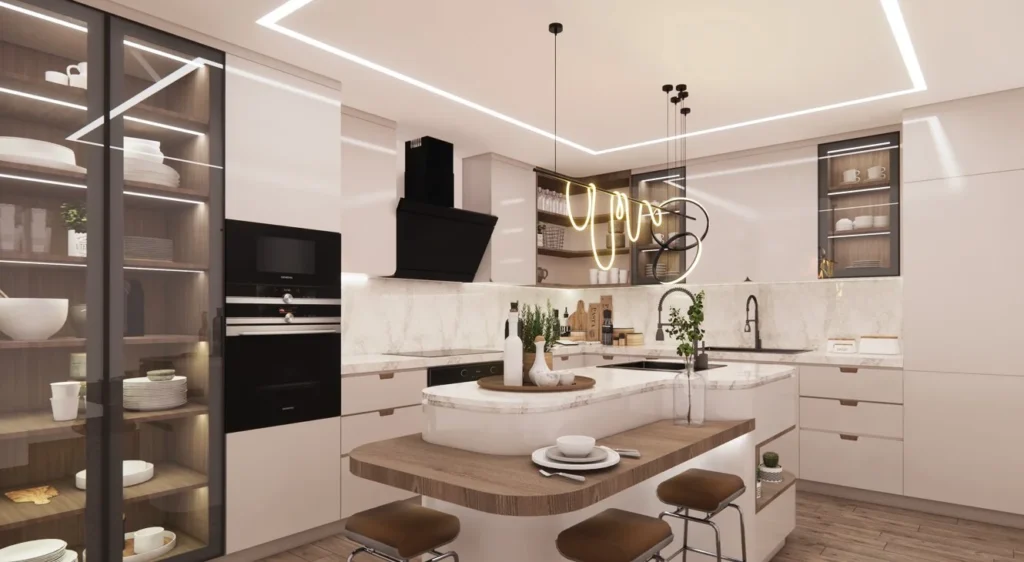
Small doses hold up better than most people expect. A pale handleless kitchen with a subtle stone splash and a wood table gets most of the effect for a fraction of a fully clad room. So does a cream one where marble appears only on the backsplash and the island face, flat color and wood everywhere else. Neither is trying to be a stone showcase.
Put the colored slab on the island where people look at it and where the acid mostly is not. Run something dull along the perimeter where the chopping happens. Buy it honed. Anybody who cannot tolerate a counter that visibly ages should not be buying marble in any color at any price. Every slab in every kitchen photograph saved to a moodboard has picked up marks by now. They were all shot the week they went in.