


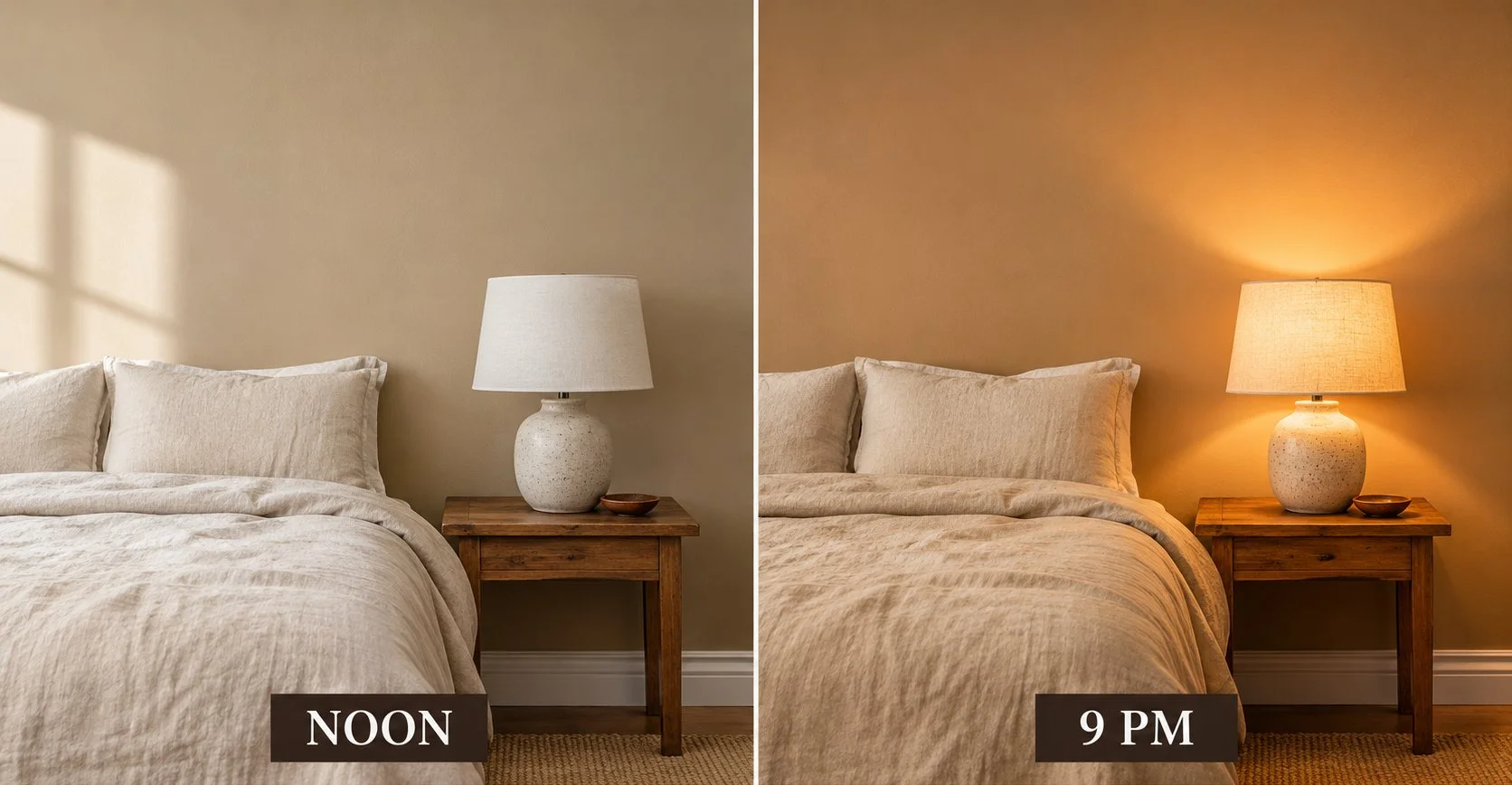
Add up the hours you actually see your bedroom walls in daylight. For most working adults it comes to half an hour in the morning plus whatever weekends allow, against two or three hours every single evening under lamps. The room is a night room. Yet every tan swatch ever taped to a bedroom wall gets judged at noon, which is the one hour of the day the room will almost never be that color again.
That mismatch is the whole problem with picking tan, because tan is the family most changed by warm light. Get the night version right and the day version takes care of itself. Get it backwards and the calm sand you approved at lunchtime greets you every evening as gold.
Warm Bulbs Repaint The Wall Every Evening
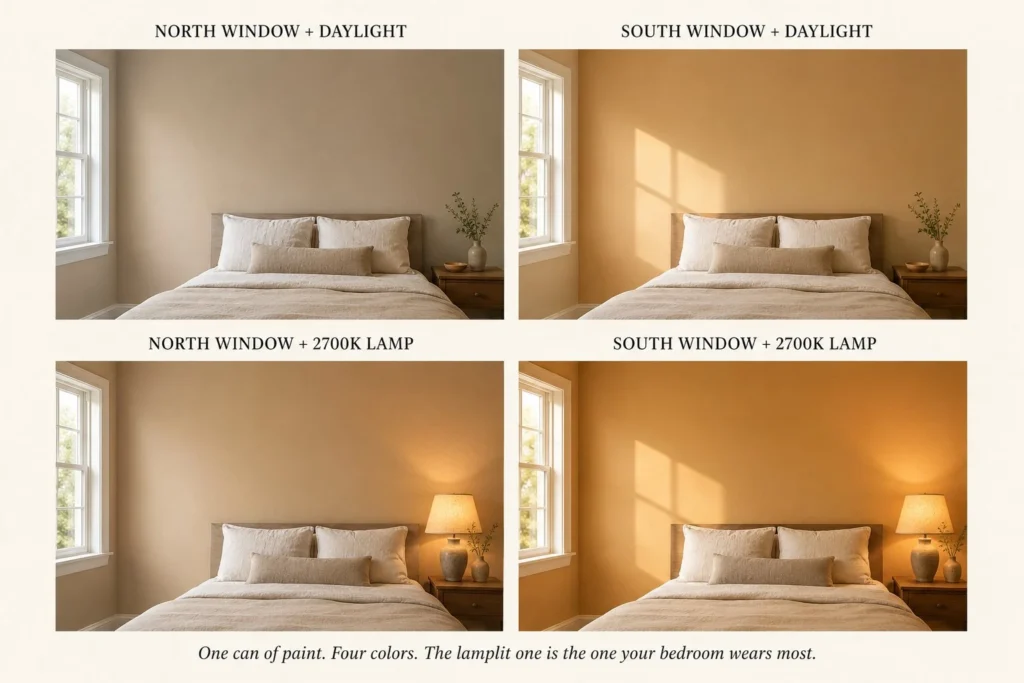
This is documented behavior, not superstition. Reviewers of Canvas Tan note that warm bulbs pull out it’s peachy and golden tones while cooler LEDs keep it feeling more neutral and grounded. Softer Tan reads as a gentle sandy beige in bright daylight, then it’s golden-brown undertones come forward under warmer evening bulbs. Nomadic Desert appears lighter and more sandy in bright daylight, while lower or warmer lighting brings forward it’s pink-beige character. Three different tans, one pattern: the undertone that hides at noon clocks in at night.
Daylight direction sets the baseline the bulbs then push on. North-facing rooms run cooler and slightly blue, muting light colors, while bright southern light can push a warm tan like Kilim Beige toward amber, even burnt sienna. So a single can of paint is really three colors, the north-window morning version, the south-window afternoon version and the lamplit version. The lamplit one is the version a bedroom wears most.
The test that settles it costs a sample pot and one evening. Paint a board at least two feet square, stand it against the actual bedroom wall, then look at it at 9 pm under the lamps you own, not the ceiling fixture you never use. Stagers who review these colors professionally recommend bulbs in the 3000 to 3500 K range for the most natural-looking color results, which is worth checking before blaming the paint: a 2700 K bulb, the standard soft-white sold everywhere, sits below that range and adds gold a bedroom lamp with a 3000 K bulb never would. Half the tan complaints on the internet are bulb complaints wearing a paint costume.
Eight Tans With Their Numbers And What Each One Does After Dark
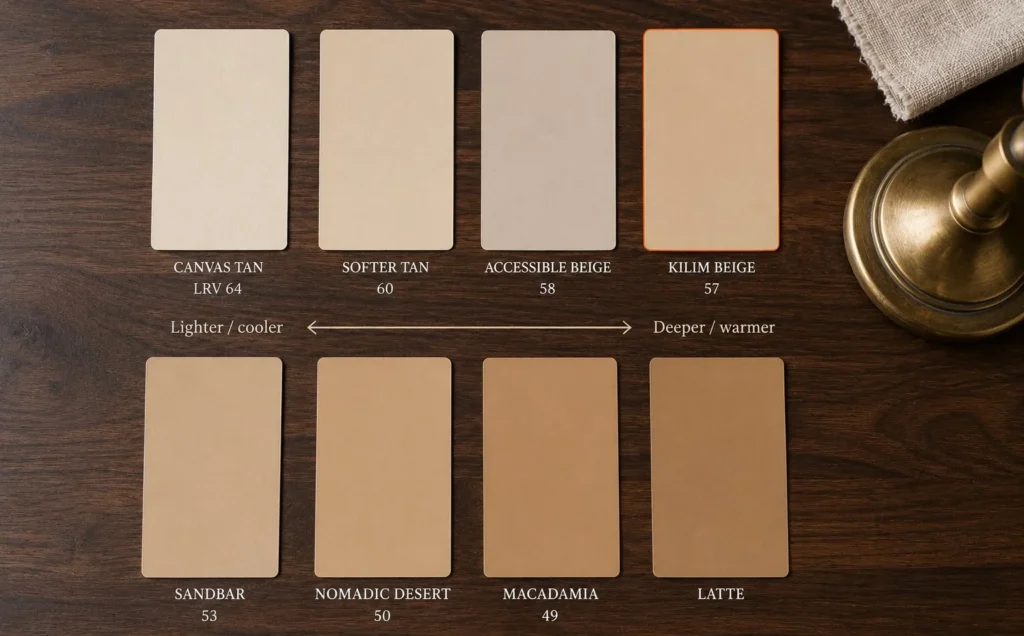
The specs below come from the color-review trade rather than the paint chips, since the chips print no undertone warnings.
| Color | SW number | LRV | Undertone | At night under warm bulbs |
|---|---|---|---|---|
| Canvas Tan | SW 7531 | 64 | Yellow family, light | Goes peachy-gold, stays light |
| Softer Tan | SW 6141 | 60 | Disputed, see below | Golden-brown steps forward |
| Accessible Beige | SW 7036 | 58 | Gray | Warms least of the eight |
| Kilim Beige | SW 6106 | 57 | Orange with pink | The pink can flash |
| Sandbar | SW 7547 | 53 | Muted yellow-green | Warms to a quiet khaki-gold |
| Nomadic Desert | SW 6107 | 50 | Orange, rosy | Pink-beige comes forward |
| Macadamia | SW 6142 | 49 | Brown, golden | Deepens, can turn heavy |
| Latte | SW 6108 | Deeper mid-tone | Orange | Richest of the strip at night |
A few of these deserve more than a row. Kilim Beige is the famous one and the famously complained-about one. Sherwin-Williams itself classifies it as an orange paint color. Alongside the orange it carries a slight pink undertone that shows from time to time. In unbalanced lighting it can have a brief moment of peachiness, since it sits on a red-yellow base. That is the mechanism behind every “my bedroom turned pink” thread: the pink was in the can all along, waiting for a warm bulb and a west window to say it out loud. At LRV 57 it holds decent depth against white trim, which is why it stays popular anyway.
Softer Tan earns it’s “disputed” cell honestly. One review calls it a true tan free of pink or yellow undertones, while another finds the same orange undertone as Kilim Beige with a wink of yellow and a tiny flash of green. Two careful reviewers, same paint, opposite verdicts. I read that disagreement as the most useful fact on this page, because it means undertones are not properties of the can so much as of the can plus your light, which is the entire argument for the 9 pm board test.
Accessible Beige is the escape hatch. It runs a gray undertone, sits at LRV 58 and behaves as a greige rather than a true tan, pairing with cooler colors and darker woods where Kilim Beige wants warmth. It is also Sherwin-William’s most popular beige. The reason is right there in the table: it is the one warm bulbs move least. Anyone burned once by a tan going gold at night tends to land here on the second try.
And a caution on the dark end. Macadamia carries a dominant brown undertone that can overwhelm smaller spaces and rooms with little natural light, which describes a fair number of bedrooms. At LRV 49 it needs either a big window or a lot of lumens. A bedroom lit for sleep rarely has the lumens.
Match The Tan To The Window, Then Buy One Step Less Warm
The window does the first sort. A north-facing bedroom, already cool and a little blue by day, takes the grayer and lighter end of the table, Accessible Beige or Canvas Tan, because the room needs the help and the evening bulbs will supply warmth the window never did. A south-facing bedroom can afford the golden middle, Sandbar, Softer Tan, even Kilim Beige, with the understanding that summer afternoons will run hot on the wall. Small or dim rooms stay above LRV 55 or accept living with lamps on.
Then the step-down rule, which is opinion built on the pattern above, so take it as that: whichever tan wins the daylight audition, buy the chip one notch cooler or grayer, because the evening bulbs will hand the warmth back with interest. The daylight favorite is the one that turns gold at 9 pm. The slightly-too-cool runner-up is the one that turns correct.
Trim stays warm either way. Kilim Beige and it’s relatives want a warm white on the trim, since a cool white throws the balance off. A stark bright white next to any of these eight will make the wall read darker and more orange than the fan deck promised.
The paint counter has none of your light. It runs bright, even, cool commercial fixtures calibrated for reading labels, which is a lighting condition your bedroom will never reproduce at any hour. Whatever the chip does under those lights is a color that does not exist in your house.